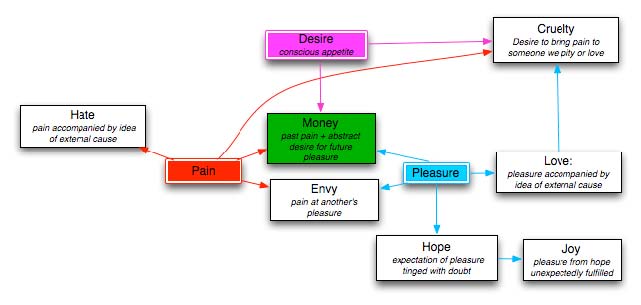
Derman defines "money" as "past pain in the service of desire to survive as well as abstract future pleasure." He writes that "Hope is the expectation of future pleasure tinged with doubt. Joy is simply the pleasure we experience when that doubtful expectation materializes. Envy is pain at another’s pleasure."
Thursday, June 6, 2013
Money, Desire, Pleasure, Pain: Spinoza and Derman
In a thoughtful and provocative little essay, Emanuel Derman reads financial markets through the lens of Spinoza's moral geometry of the Good. In "Money, Desire, Pleasure, Pain," Derman (who is Professor of Financial Engineering at Columbia, and a principal in Prisma Capital Partners) shows how money triangulates with Spinoza's "primitives" of desire, pain, and pleasure. He defines "work" as pain in the service of desire.

Derman defines "money" as "past pain in the service of desire to survive as well as abstract future pleasure." He writes that "Hope is the expectation of future pleasure tinged with doubt. Joy is simply the pleasure we experience when that doubtful expectation materializes. Envy is pain at another’s pleasure."
Tuesday, May 14, 2013
High-end Coffee and Maya Farmers in Guatemala
As with fine wine, provenance and terroir have become key elements of value in the world of high-end coffee. Like wine, coffee’s complex flavor profile is especially sensitive to climate, moisture, and soil conditions; and the highest priced coffees are varietals provenanced from single estates. In 2012, Korean buyers paid $500.50 a pound for a micro-lot of that year’s mocha varietal from the Guatemalan finca El Injerto (bought by YT Infinite, doing business as Brian's coffee). The entire lot was only 8 pounds, but the benchmark New York commodity price at the time was just about $170 per hundredweight, meaning that the El Injerto mocha sold for almost 300 times the going rate for washed arabicas.
I did not try this $500 coffee, but I have sampled a number of El Injerto’s more reasonable (if still pricey) alternatives. They produce my favorite coffee by far, with a deep, almost smoky, base and highlights of dark berries and citrus. Tastes vary, but by El Injerto holds its own with the very best. The owner of El Injerto, Arturo Aguirres, told me that until the late 1970s, they transported all of their coffee by mule, as they were no passable roads, and they he continued to plant the high altitude exotic varietals (Mocha, Pacamara, Maroquipe) even when they were not selling, because they were good coffees and he took pride in his coffee production. When others were switching their land to rubber and palm trees, Aguirres held out. And now it is paying off with the premiums his specialty coffees command. (See also Allison Aubrey's NPR piece on Journey of a Specialty Coffee Bean from Cherry to Cup.)
Are his coffees worth $6.60 a cup wholesale (and FOB Huehuetenango, Guatemala)? If it is what the market will bear, one could argue, then it seems that they must be. "Objective" quality (by established tasting standards) and market scarcity play an important role, but we cannot discount the symbolic values at play: the relative positioning of conspicuous consumption; the imagined, personal relationship with a producer (and his inspiring story); and underwriting it all, the cultural and market shift among the global affluent toward artisanal and singular products. Yesterday, the NY Times reports on the consumption side of such coffees at high-end retailers such as Stumptown and Intelligensia.
Throughout the twentieth century, coffee production in Guatemala was a highly concentrated industry composed of a small number of very large producers. These cafetaleros operated privately owned plantations (fincas) and depended on temporary, migrant labor to deliver what had become a high volume, low cost commodity product. The large producers traded with equally large and concentrated exporters and roasters who then completed the global value chain; this was the coffee that found its way into cups around the world as Folgers, Maxwell House, and hundreds of other brands. In the largely Maya highland communities where labor was recruited, working on coffee fincas was, and is, seen as employment of last resort because of the low wages and harsh conditions.
Today, we find a large number of former coffee laborers and subsistence farmers supporting their families by growing and selling their own coffee. The rapidly proliferating number of small producers—at least 50,000 new growers over the last 20 years, doubling the number of producers in Guatemala—has significantly altered the face of Guatemalan coffee. In the western highlands, the vast majority of these new producers are indigenous. They are cultivating increasingly differentiated varieties of high quality coffee on their own small parcels of land using family labor, and increasingly hiring day workers; a majority process and sell their coffee through a cooperative. Their production is sometimes sold as domain-specific varietals directly to small and medium sized roasters around the world rather than disappearing in vast, undifferentiated lots of commodity.
In a recent study, Bart Victor and I look at how coffee plays into the desires of Maya farmers for a better life. Aguirres is not typical of the group—a ladino, relatively affluent, a third generation coffee farmer—but the prices his provenanced coffee commands dramatically illustrate the high end of this new market, and the potential for other farmers. El Injerto operates at the very upper end of the market, but the demand for quality and provenance has driven up prices for all of the high altitude Guatemalan producers, most of whom are today relatively smallholding Maya farmers.
There is dignity, many of these farmers told us, in working one’s own land, being one’s own boss, and they see coffee as a potentially lucrative way to keep their own production and be finically independent. They view seasonal plantation labor as a form of dependency, wrought with the hardships of being separated from one’s family, that they want to avoid if at all possible. They also prefer to hold wealth in land, and see coffee production as a way of expanding land holdings (or first time buying). The farmers we interviewed overwhelmingly want to get ahead, to achieve algo más in their lives, to see their children flourish, and they see coffee as a partial route to that. See Jennifer Johnston's piece on Consumer taste for high altitude beans shifts opportunity to small farmers.
We did our study in 2011, right after the March 31 peak New York C price of $298.93 (per hundredweight); two years later it has fallen to $135.43 (see price chart below). At the same time the Coffee Rust fungus threatens large portions of Guatemalan production (estimates range from a drop of 15% to as high as 50% next year). Price drops and coffee rust are certainly hitting the new entrant smallholders the hardest, and Bart and I hope to do follow up studies over the next year to see what impact this has had and farmers' livelihoods.
Labels:
coffee,
gourmet coffee,
guatemala,
Maya
Tuesday, May 7, 2013
Economics and Anthropology: Stated Preferences, Dignity, and Pleasure
Noted economist Daniel McFadden makes a radical call for his field to pay more attention to the insights of anthropology and other disciplines in his NBER Working Paper "The New Science of Pleasure." Summing up lots of recent research, McFadden claims that economics needs to look other fields not just to explain irrational anomalies, but to consider that complex subjects are the norm. As The Economist puts it, "Homo economicus, not his fallible counterpart, is the oddity."
McFadden is on comfortable disciplinary ground in arguing for the inclusion of insights from behavior economics and psychology--the endowment effect, hyperbolic discounting, and other such cognitive quirks have been well documented by Daniel Kahneman and others.
Where McFadden pushes the envelope is his call for incorporating anthropological and social science perspectives into economic modeling to understand the role of identity, social relations, and persuasion in decision making.
The manuscript I just finished (The Good Life: Aspiration, Dignity, and the Anthropology of Wellbeing) echoes a number of McFadden's observations, which I take to be an encouraging sign of the changing zeitgeist. For example, while economists have long privileged revealed preferences (observable behavior) we need to take more seriously stated preferences (what folks say they want to do). Revealed preferences are taken by economists to be more real: it is thought that when the rubber hits the road and the cash changes hands, one reveals one’s true preferences. At the same time, a laser focus on revealed preferences discounts the importance of the cultural—the fact that choices are delimited, as in the all too common scenario we are faced with on the grocery store aisle and in the voting booth of choosing between the lesser of evils. Stated preferences, in not being bound to the immediate here-and-now, often take a longer-range view of overall preferences and ideals. Stated preferences are more likely to be concerned with non-material values; these are given more weight in the long term project of one’s life, one’s overall wellbeing. Often they are connected to identity.
In my book, I also focus on the role of dignity and fairness, which The Economist also neatly highlights in their review of McFadden's paper: "Dignity is not something mainstream economics has much truck with. But creating a sense of dignity turns out to be a powerful way of affecting decisions." It is also a key element of wellbeing.
McFadden is on comfortable disciplinary ground in arguing for the inclusion of insights from behavior economics and psychology--the endowment effect, hyperbolic discounting, and other such cognitive quirks have been well documented by Daniel Kahneman and others.
Where McFadden pushes the envelope is his call for incorporating anthropological and social science perspectives into economic modeling to understand the role of identity, social relations, and persuasion in decision making.
The manuscript I just finished (The Good Life: Aspiration, Dignity, and the Anthropology of Wellbeing) echoes a number of McFadden's observations, which I take to be an encouraging sign of the changing zeitgeist. For example, while economists have long privileged revealed preferences (observable behavior) we need to take more seriously stated preferences (what folks say they want to do). Revealed preferences are taken by economists to be more real: it is thought that when the rubber hits the road and the cash changes hands, one reveals one’s true preferences. At the same time, a laser focus on revealed preferences discounts the importance of the cultural—the fact that choices are delimited, as in the all too common scenario we are faced with on the grocery store aisle and in the voting booth of choosing between the lesser of evils. Stated preferences, in not being bound to the immediate here-and-now, often take a longer-range view of overall preferences and ideals. Stated preferences are more likely to be concerned with non-material values; these are given more weight in the long term project of one’s life, one’s overall wellbeing. Often they are connected to identity.
In my book, I also focus on the role of dignity and fairness, which The Economist also neatly highlights in their review of McFadden's paper: "Dignity is not something mainstream economics has much truck with. But creating a sense of dignity turns out to be a powerful way of affecting decisions." It is also a key element of wellbeing.
Tuesday, April 2, 2013
Future Virtues and Current Choices
What we say we want is not always what we do, but that doesn't mean that we are always lying or deceiving ourselves (although we may do that too). What we say is often what we really want, even if we sometimes stumble in practicing what we preach. That might seem self-evident to therapists and priests, but it poses a big problem for economists and policy makers (whose models usually assume that we reveal our true preferences in deed and not word). As I argue, our stated preferences may be harder to model but, in looking to the future, also tend to be more pro-social, more concerned with the common good.
It turns out there is some experimental proof for this idea. Tal Eyal, Nira Liberman, and Yaacov Trope have devised studies that suggest that "people judge immoral acts as more offensive and moral acts as more virtuous when the acts are psychologically distant than near. This is because people construe more distant situations in terms of moral principles, rather than attenuating situation-specific considerations" (from a 2008 article "Judging near and distant virtue and vice" in the Journal of Experimental Social Psychology).
This has implications not only in the rarefied world of virtue studies. It turns out that we act in ways counter to what we say we want all the time in little ways. The NY Times Sunday reported on research by Alessandro Acquisti that shows that people say they place a high value on the privacy of their personal data, but are quick to give that up in the moment when filling out online forms.
We sometimes need a little help to do what we want to do; paradoxically, sometimes regulation and restrictions can help us be more free to be who we want to be.
It turns out there is some experimental proof for this idea. Tal Eyal, Nira Liberman, and Yaacov Trope have devised studies that suggest that "people judge immoral acts as more offensive and moral acts as more virtuous when the acts are psychologically distant than near. This is because people construe more distant situations in terms of moral principles, rather than attenuating situation-specific considerations" (from a 2008 article "Judging near and distant virtue and vice" in the Journal of Experimental Social Psychology).
This has implications not only in the rarefied world of virtue studies. It turns out that we act in ways counter to what we say we want all the time in little ways. The NY Times Sunday reported on research by Alessandro Acquisti that shows that people say they place a high value on the privacy of their personal data, but are quick to give that up in the moment when filling out online forms.
We sometimes need a little help to do what we want to do; paradoxically, sometimes regulation and restrictions can help us be more free to be who we want to be.
Monday, February 18, 2013
Voicing Dissent: A Conversation with Lewis Lapham
I heard a podcast recently of AlecBaldwin interviewing Lewis Lapham. Ifyou aren’t familiar with his writing, Lapham is arguable the country’s finestcontemporary essayist. Editor emeritusof Harper’s Magazine, and the founderand editor of Lapham’s Quarterly,Lapham writes essays that are often lyrical and frequently satirical, weavingliterary and historical references into biting political and cultural critiquesthat challenge conventional wisdom.
Laphamhas also led a remarkably iconic twentieth century life, something that theinterview with Baldwin captured well. What was missing, though, was Lapham’s usual stinging critique. Thus, Iam pulling out of the vaults an interview I did with Lapham in 2004, when hewas still editor of Harper’s.
Granted,Lapham is not your traditional anthropological subject. He wears a finely cut, if slightly crumpled,suit instead of exotic dress. In placeof a foreign tongue he speaks the sort of standard English that reveals anexpensive education. Yet, as a culturalanthropologist, I was drawn to Harper’s lower Broadway offices in Manhattan tointerview Lapham because of his very anthropological take on the decline ofdissent in our country.
Whilesome might argue that his writing is too erudite for mass consumption, Laphamconsistently sullies ivory tower presumptions with the gritty concerns of dailylife, revealing the inequalities hidden in hegemonic ideologies not through pristinetheory but, to borrow a phrase from Michael Taussig (1987:288), by looking “inthe sweaty, warm space between the arse of him who rides the back of him whocarries.” Lapham is of the dominantclass but openly subverts its pretensions.
Lapham grew up in San Francisco,the great grandson of a minor robber baron and the grandson of a spendthriftwho blew through his share of the family fortune. Little Lewis listened to the stories ofone-great wealth as a child, having been raised with “some of the attitudesassociated with being born within the compound” but without the money to gowith it. Still, his education was of aparticular sort: prep school at Hotchkiss, college at Yale, and further studiesat Cambridge.
When I met him, Lapham was aslender, distinguished looking man in his late 60s. His comfortable self-assurance andchain-smoking manner suggest a college professor more than a mediaexecutive. He had just published acollection of essays, The Gag Rule (2004), in which he looks at how dissent is mutedin modern society. He shows that thenature of big media concerns, the emergence of new communication technologies,and the state of public education have converged to form the perfect hegemonicstorm in the United States. Rather thanstirring up public discontent, this tempest acts to mute discontent, andbrilliantly does so in the guise of greater freedom of choice.
EFF: In your new book you write about what youterm “the mute button.” What is it?
LL: The obstacles standing in the way ofdissent, candor, and honest sharp-edged, open public argument. James Fenimore Cooper, in the book TheAmerican Democrat, makes the point that of all the American politicalvirtues, candor is the most necessary. Cooper’s point is that the democratic idea means that we try to telleach other the truth. Somehow, if we dothat, even though both of us may be wrong, we manage to correct our errors andtherefore plot a course that neither one of us could have done alone but thatwill see us safely through to the future. Or to Oregon, as the case may be. So dissent is the collective expression of candid opinion. In the definition of Archibald MacLeish, dissent is nothing more thanthose indications when people think for themselves and do not simply mouth theconventional wisdom. The mute button iswhat stands in the way of candor in our modern times.
EFF: How does the mute button work?
LL: There are several elements to the mutebutton. First is the nature of the largenews the media, which in my view is better associated with the characters ofRosencrantz and Guildenstern than it is with the lonely voice of thewhistleblower or truth teller on the ramparts of freedom. This is because so much of the large media isdependent upon access to power. When onebecomes accustomed to accepting handouts (literally, as that is the term usedby the media: the “press handout”), the journalist more often than not is thefigure on bended knee who accepts this gift with gratitude. There is wonderful image of it in the panicof 1894: the stock market fell to pieces, many were unemployed, fortunes werelost, and the press went down to Wall Street to get a statement from eitherE.H. Harryman or J.P. Morgan. They satin the anteroom of the great banker’s office for four hours, with their hats ontheir knees, and finally a secretary appeared and handed them a piece of paperon which was typed “The United States of America is a great and growingcountry” and, in parentheses, that “this is not for attribution.” That was the sum of the statement theyreceived, but they were grateful for it, bowed, and brought back the great newsto the New York world.
EFF: The mute button also calls to mind theremote control and the multitude of channels that we have these days watched bymultitudes of passive viewers.
LL: This is the second element of the mutebutton: the nature of the electronic media, with the sheer white noise of somany channels and so much available on the internet. There is so much white noise that it is hardto make a clear statement. Anddissent--which implies thought, which implies argument--does not lend itself totelevision because television is sound-bites, television is emotion, not rationalthought.
Television is aworld in which there is no cause and effect: It is an eternal present, aneternal now. There is no past, there isno future, and nothing necessarily follows anything else. All the world’s sorrow, joy, tragedy, horrorhas to be condensed into however many minutes there are betweencommercials. Given the way thattechnology is now working (with the hundreds of channels and Direct TV andsatellite) you can literally sit there with a remote control and find the worldin whatever mirror flatters your own sense of yourself. At any one time, if you have enough channels,you could find the person of the president of United States presented asRichard Nixon himself, as Anthony Hopkins as Richard Nixon, as Morgan Freeman,as Harrison Ford, as John Kennedy himself. It goes on and on. At the verysame time, you can then go directly to a pornographic channel and from there toa sporting event in Peru and then to a ship lost at sea and then to an episodeof some police drama or reality t.v.
In other words,there is no sequence, there is no coherence with television as there is on theprinted page. The printed page isstraight lines, more or less, like roads or the plot in a Jane Austinnovel. This is not true on television—itis circular instead of linear. And thatsensibility is tuned to improvisation as opposed to argument, to emotioninstead of thought, and is not conducive to the expression of dissent becausethe sharp-edged argument on television would seem impolite, rude, and out ofplace. The character that works ontelevision is bland and one on which images can be imposed, not an image orpersonality that is so sharply defined as to discourage its occupation by theviewer.
EFF: The the real the insidiousness of all thesetelevision channels, of the modern media as compared to 100 years ago, is thatwe have an image of so much dissent and diversity on television and yetit is just an image . . .
LL: Yes, it is an image, and it is oftenpresented simply as entertainment.
EFF: This would also apply to the trend inAmerican schools toward edu-tainment—the idea that learning must be fun andentertaining.
LL: This is the third element of the mutebutton, the state of American education. Critical thinking is not uppermost in the minds of most of the nation’sschoolmasters. There is a set of correctof answers and if you know them you get an “A,” but doubt, argument, criticalthinking--to question the wisdoms in office, whether they are literary orpolitical—is lacking. There is not muchof American history either. It’s hard todissent unless you have some knowledge, it cannot be done ex nihilo. We don’t teach the story of American historyvery well in our schools, and that’s true for private schools I think as wellas the public schools, and the universities as well as grammar schools.
Woodrow Wilsonsaid, addressing the High School Teachers Association in 1909 when he was thepresident of Princeton, that we want two classes of persons in the UnitedStates: one very small class to whom we will grant the privileges of a liberaleducation and one--a much larger class--of mechanics who will be consigned tothe dreary, menial tasks required of an industrialized society (and there is nopoint in teaching them too much or encouraging them to think for themselves). The notion of a dissenting, actively thinkingcitizenry is not good for the advertising business. What we want is the easilyabused consumer, not the critical, thoughtful citizen. We don’t teach citizenship, we teachmarketing.
EFF: How, then, do these forces come together tomove individuals to act against their own self-interests?
LL: Allied to the elements of the mute is ahappy return to religious superstition and to magical thinking, which isovercoming not only the news media but large segments of the population. This is encouraged by television. Television is a form of magicalthinking. It has more to do with ritualand is passive rather than active. Sothat you have the phenomenon of somebody who sees perfectly clearly that theBush administration made a mess of our “liberation” of Iraq and yet ignores theevidence and chooses to believe that President Bush is a man of great characterand integrity.
We set aside theempirical evidence in favor of the preferred, magical, superstitiousbelief. Somebody once said that“incompetent armies deify the commander.” And there we are. Or you have thephenomenon of the person who lives in the rustbelt, in Ohio or in a state thathas lost fifty thousand jobs or maybe two hundred thousand jobs in the lastfour years, and here is the person who is making a salary of $40,000 ayear. Every political and economicself-interest—you would think—would encourage this person to vote against theBush administration. But not so: theyshift. It is a bait and switch. Rather than political and economic questionsabout justice, we have moral questions about character.
EFF: And this moves us away from theenlightenment ideals of reason upon which the country was founded?
LL: That is the title of Henry Commager’sgreat book The Empire of Reason, which was about formation andformulation of the United States as the practical, political working out of theenlightenment idea: European theory, American practice. But it appears that idea has run its course,at least in the United States. It is 200years later and with what do we replace it? We seem to be replacing it with a return to superstition, a movebackward. The hard question is how wereplace it with something that carries us forward towards a better place forlarger numbers of people. I don’t knowwho is going to formulate that or on what basis or how one would give it thestrength of religion. It is much more difficultto sell a secular idea of paradise (either here or there) than it is to sell itwith a miracle and faith. Theexistential proposition is a very frightening one: most people are scared offreedom. There is a great speech in Dostoevsky’s The Grand Inquisitorthat says the only thing that people really want is magic, mystery, andauthority and as soon as they are free they become terrified. This is Aldous Huxley’s point, this isOrwell’s point—the distopias all take this into account. So did the Third Reich. This is the question--and I don’t have anyanswer to it--that we should be addressing and that the Democratic party shouldhave been addressing and trying to give that set of notions a politicalstructure. They haven’t done that.
EFF: You write that the dumbing down of schoolsis no accident, that it is by design . . .
LL: It’s by design, that’s true.
EFF: But isn’t that too conspiratorial? Is there some cabal of big media andgovernment and academic leaders plotting the demise of our schools?
LL: No, it’s not that way. I made that argument as an inference. I started out by saying that we are a countryof very intelligent people with enormous resources—in other words we have themoney and the brains to build a truly first-rate school system. We once had that in this country. The public schools in California in 1930s and1940s were truly good, as were many of the city colleges in New York. We have let that deteriorate: collectively,we don’t put that much value on first-rate schools because (and it’s not aconspiracy) one does not want to have troublesome students asking too manyquestions for which there are no answers. Or for which the answers are hard to arrive at. So it is not a conspiracy, it is a kind ofconsensual response to a world that suddenly becomes much more frightening withthe invention of the hydrogen bomb. Weare now in the shadow of our own powers of Armageddon.
Then there is theenormous expansion of knowledge. In the 19th century it was stillpossible for men to believe that they could know all that was to be known—lookat the Encyclopediasts in France. By 1960, if you graduated in physics, tenyears later everything that you knew would be obsolete. Knowledge was expanding at light speed in somany different fields that it encouraged a response of “we can’t know.” And if we can’t know, then everything ismatter a rumor and faith. What you knowis just as true as what I know and history is simply a costume trunk from whichwe can dress up in merchant ivory in any way we choose. It all becomes magic, we go back to thefirelight in the cave and those are the images on television 24/7. We begin to believe in Scientology. Look at the advertising for drugs ontelevision now—what are they advertising? A whole parade of new drugs, and many of them don’t even tell you whatthey are supposed to cure. It’s justlong life. It’s just a blue pill--andthey never tell you why or what its about. It’s like a fountain of youth. The other thing they advertise is Viagra (three or four forms ofit). We are back to primitive rituals,people dancing around maypoles, bacchanalia and ritual that become increasinglyprimitive.
This is a visionthat the future that can be bought instead of earned. It is as if excellence were some form of verygood suit or well engineered SUV, whereas the existential situation is lonely,full of doubt and not likely to lead to riches or worldly success. You could say that in the world of theprinter, in the world of the 18th century, in the world of theEnlightenment, it was “truth as passion.” In the word of the media it is “passion astruth.” That is a much moreprimitive formulation, it is ritual and Viagra and the magic pill.
EFF: So do we need a revolution to set thecountry on the right course?
LL: Probably. Or we need some form of secular awakening, some understanding that wemake our freedom with politics--something made by men for other men in theworld of time. We have to recover thatsense of the Enlightenment, reverse the American retreat from the faith inreason to the comfort of religious certainty and superstition, which of courseis very close to George Orwell’s notion that ignorance is strength. For 200 years much of the rest of the worldhas looked towards America as the light of the future and the hope of mankind,and I don’t think that’s the case now. The rest of the world still looks to America as a market, a place to getrich and sell their goods, but I don’t think it looks to America as a politicalideal. We are not setting a very goodexample. From what I know of them (and Iam sure they have their flaws), European societies--France or Germany, evenItaly and certainly the Scandinavian countries--seem to me closer to the ideaof a just society.
It is no accidentthat we rate so low in infant mortality, longevity, quality of life, cost ofmedicine, degrees of education. We don’tstand very well on those lists and it is because we have translated the notionof the American dream into enlightened selfishness. And that is not a dream that is very well suitedto the circumstances of the 21st century. Maybe it was a consummation greatly to bewished in the 19th century and the 20th century when theabundance of our resources was such that we could afford to ravage the land andthen move on across the next set of mountains and plunder the next valley, whenthere seem to be no end to water and pasture and so the American dream became akind of nomadic browsing of the country’s natural resources. But now that isn’t going to work so well aswhen we thought we were protected by the two oceans, inhabiting a city on thehill in an Arcadian world out of time. That doesn’t work in a world that has become, as we never tire ofsaying, interdependent, when disease can cross frontiers as easily as debt andwhen of none of the major problems in the world are available to solutions byany single nation. If we are talkingabout the environment, climate, disease, war, terrorism--all of these thingsare contagious and spread very easily across borders. Thus, the notion of “everything for me andnothing for anybody else (or as little for anybody else as possible)” is simplynot tenable except by increasing demonstrations of force.
Labels:
Lewis Lapham
Monday, February 11, 2013
Money and Happiness, Redux
Adam Davidson (of Planet Money at the NY Times Magazine's It's The Economy column), turns his eye to recent happiness research, and finds that "money actually does buy happiness." That's the headline, anyway. In fact, and as usual, Davidson's reporting shows that it is a bit more complex than that.
The headline-grabbing findings come from the work of Betsey Stevenson and Justin Wolfers, who show that this is a broad correlation between GDP per head and levels of life satisfaction (and refer to previous posts for the distinction between "happiness" and "wellbeing" or "life satisfaction" that are often conflated):
This seems to contradict the Easterlin Paradox that more income doesn't produce more happiness between countries. Yet, as Davidson points out, there are some exceptions, including the U.S. over the last forty years (where income has tripled while happiness levels have not gone up).
It is also the case, as Davidson hints at, that high levels of income are often associated with other things that produce wellbeing and life satisfaction, such as access to opportunity, security in personal safety, and mechanisms to mute inequalities. More income and a booming economy often do open new opportunities and increase folks' abilities to lead the lives that they value. But they don't have to; it isn't a case of direct causation. And that means that public policy would do well to pay attention to how growth can nurture the conditions that lead not just to more income for income's sake but to overall wellbeing. (As Tony Schwartz argues in the same issue of the Time's as Davidson's article, working longer and harder is not always the answer, in terms of wellbeing and productivity.)
The headline-grabbing findings come from the work of Betsey Stevenson and Justin Wolfers, who show that this is a broad correlation between GDP per head and levels of life satisfaction (and refer to previous posts for the distinction between "happiness" and "wellbeing" or "life satisfaction" that are often conflated):
This seems to contradict the Easterlin Paradox that more income doesn't produce more happiness between countries. Yet, as Davidson points out, there are some exceptions, including the U.S. over the last forty years (where income has tripled while happiness levels have not gone up).
It is also the case, as Davidson hints at, that high levels of income are often associated with other things that produce wellbeing and life satisfaction, such as access to opportunity, security in personal safety, and mechanisms to mute inequalities. More income and a booming economy often do open new opportunities and increase folks' abilities to lead the lives that they value. But they don't have to; it isn't a case of direct causation. And that means that public policy would do well to pay attention to how growth can nurture the conditions that lead not just to more income for income's sake but to overall wellbeing. (As Tony Schwartz argues in the same issue of the Time's as Davidson's article, working longer and harder is not always the answer, in terms of wellbeing and productivity.)
Friday, February 1, 2013
The Remarkable Folks of Tuskegee
Work called me to Tuskegee, Alabama this weekend, to pay a visit to the storied Tuskegee Institute (now known as Tuskegee University). Truth be told, I wasn't looking forward to the drive or the trip. My New Year's resolution was to travel less, and every little trip eats into my sense of resolve. But this turned out to be one of the most rewarding.
Tuskegee is a remarkable place. Well, the town itself looks to be a pretty run-of-the-mill poor, rural Alabama community. (Having grown up in nearby Dothan, I'm familiar with the type.) But The Institute (as it seems to still be most commonly called) is a vibrant place that recalls the vision of its founder, Booker T. Washington, to provide a top-notch education to African-Americans, to instill a sense of personal improvement tied to the collective good.
One of the events we sponsored there was a K-12 teacher workshop on the Cuban literacy campaign. I was approached by a middle-age white man at one point, who greeted me and struck up a conversation. Mr. Rogers said that he teaches 7th and 8th and 12th grade history in his town of Tallassee, Alabama. As I probed more, it turned out that this was but one of his vocations. He also coaches (basketball, baseball, and football), and plays an important role in the town volunteer fire department and frequently drives the water truck. And he is a Baptist minister, preaching on Sundays. The school he teaches at has 75-80% of the children on free lunches; more than half live with their grandparents or other relatives. But Mr. Rogers is passionate about their education, and he brings them to the Tuskegee archives to teach them about the local struggles for civil rights. He himself has seen a lot. His dad was a State Trooper in Selma in the sixties, and Mr. Rogers remembers seeing his father hold the line against protesters marching across the bridge there. And today, here he is, a white Baptist minister in Tallassee, Alabama doing all he can to even the current laying field for the kids he teaches.
Mr. Rogers didn't tell me all of this to brag. Indeed, I had to pull it out of him. It is just what he does, not something to make a fuss about. And when I told him how impressed I was, and grateful that folks like him were teaching, he said, "yeah, but it's not as important as what you do." And he meant it, although quite the opposite is true. I may have been wearing a nicer tie than he was that night, but the world is a much better place for having Mr. Rogers and all those like him.
Tuskegee is a remarkable place. Well, the town itself looks to be a pretty run-of-the-mill poor, rural Alabama community. (Having grown up in nearby Dothan, I'm familiar with the type.) But The Institute (as it seems to still be most commonly called) is a vibrant place that recalls the vision of its founder, Booker T. Washington, to provide a top-notch education to African-Americans, to instill a sense of personal improvement tied to the collective good.
One of the events we sponsored there was a K-12 teacher workshop on the Cuban literacy campaign. I was approached by a middle-age white man at one point, who greeted me and struck up a conversation. Mr. Rogers said that he teaches 7th and 8th and 12th grade history in his town of Tallassee, Alabama. As I probed more, it turned out that this was but one of his vocations. He also coaches (basketball, baseball, and football), and plays an important role in the town volunteer fire department and frequently drives the water truck. And he is a Baptist minister, preaching on Sundays. The school he teaches at has 75-80% of the children on free lunches; more than half live with their grandparents or other relatives. But Mr. Rogers is passionate about their education, and he brings them to the Tuskegee archives to teach them about the local struggles for civil rights. He himself has seen a lot. His dad was a State Trooper in Selma in the sixties, and Mr. Rogers remembers seeing his father hold the line against protesters marching across the bridge there. And today, here he is, a white Baptist minister in Tallassee, Alabama doing all he can to even the current laying field for the kids he teaches.
Mr. Rogers didn't tell me all of this to brag. Indeed, I had to pull it out of him. It is just what he does, not something to make a fuss about. And when I told him how impressed I was, and grateful that folks like him were teaching, he said, "yeah, but it's not as important as what you do." And he meant it, although quite the opposite is true. I may have been wearing a nicer tie than he was that night, but the world is a much better place for having Mr. Rogers and all those like him.
Labels:
Tuskegee
Friday, January 18, 2013
Thursday, December 27, 2012
The Growing Divide Between Labor and Capital
Inequality in the U.S. is higher than it has ever been by many measures (see this article in Weakonomics). While the country has long had a high tolerance for inequality as compared to most parts of the world, this holds true only to the extent that it is considered "just" inequality. Inequality based on what is perceived as unfair advantage has an equally long tradition of being condemned.
There are any number of social (not to mention moral) arguments against dramatic inequality: it turns out that high inequality is associated with worse health and happiness indicators for all (not just the poor). But there is also a business and investment case against extremely high inequality.
Jon Shayne, writing on the PBS Newshour's The Business Desk, looks at the dramatic divergence of national income going to capital and going to labor. In a fascinating interview with Jon, Andrew Smithers takes on the conventional wisdom (suspect as that should always be, as John Kenneth Galbraith pointed out) about this divergence, which most attribute to shifts in technology and winner-take-all knowledge
economies. Smithers offers a different (and convincing) explanation: executive compensation has introduced a number of incentives that encourage managers to maximize short term profits at the expense of long-term investment in labor and productivity. This is both more troubling for
long-term prospects and more manageable--if we had the political will. It
is precisely in those cases where individual short-term maximization comes at
the expense of longer-term and broader publication goods that politics should
step in: to make markets work to the ends that we collectively decide on (and
investment that promotes long-term stable growth should, in theory, be an easy
one to decide on).
As I have written about previously, Bob Frank proposes a steeply progressive consumption tax that would discourage wasteful consumption while not penalizing productive investment. (See this and other policies that economists love and politicians hate at Planet Money.)
In his blog, Jon Shayne reports another immodest proposal from Josh May:namely that low P/E investments be taxed at a low rate and high (i.e. more speculative) P/E investments (at the time of purchase) have a high capital gains tax rate. As Jon points out, another alternative would be for the capital gains tax rate to become progressively lower over time (i.e. rewarding holding and long-term investment).
Tuesday, November 27, 2012
Extremists are Happiest
I've been looking at what contributes to wellbeing around the world. As reported in previous posts, beyond a basic income, health, and social relations, one of the key elements of overall life satisfaction is commitment to larger projects that go beyond the self. Such commitment can range from mastering a craft or field or sport to patriotism or religious belief to supporting a hate group. It just has to be a project that transcends narrow self-interest and gives meaning to life.
In this light, I was fascinated by a NY Times op-ed piece by Arthur C. Brooks that my brother David sent me. Brooks reports on a Pew Center study that finds conservatives much more likely to say they are very happy about their lives than are liberals. And extremists on both sides of the political spectrum, the hard core ideologues, report that they are the happiest of all. The conservative/liberal divide is not so surprising given that long term partnerships (marriage) and religious beliefs are associated with happiness, and conservatives are more likely to have both.
At first blush, the happy extremists are the puzzle. The world endlessly refuses to operate how these true believers think that it should. Certainly , this should lead to more frustration than happiness. But that is not the case. In terms of wellbeing, actually changing the world is less important than the psychological and social commitment to larger projects. The fevor of extremists beliefs bestows meaning and purpose on life's activities, whether or not they are successful. Perhaps ideological fervor brings individual life satisfaction although writ large it can certainly also reduce collective wellbeing.
In this light, I was fascinated by a NY Times op-ed piece by Arthur C. Brooks that my brother David sent me. Brooks reports on a Pew Center study that finds conservatives much more likely to say they are very happy about their lives than are liberals. And extremists on both sides of the political spectrum, the hard core ideologues, report that they are the happiest of all. The conservative/liberal divide is not so surprising given that long term partnerships (marriage) and religious beliefs are associated with happiness, and conservatives are more likely to have both.
At first blush, the happy extremists are the puzzle. The world endlessly refuses to operate how these true believers think that it should. Certainly , this should lead to more frustration than happiness. But that is not the case. In terms of wellbeing, actually changing the world is less important than the psychological and social commitment to larger projects. The fevor of extremists beliefs bestows meaning and purpose on life's activities, whether or not they are successful. Perhaps ideological fervor brings individual life satisfaction although writ large it can certainly also reduce collective wellbeing.
Tuesday, October 16, 2012
Can reducing our choices increase our happiness? PopAnth link
In Michael Lewis' recent profile of Obama in Vanity Fair, the President remarks, “You’ll see I wear only gray or blue suits. I’m trying to
pare down decisions. I don’t want to make decisions about what I’m
eating or wearing. Because I have too many other decisions to make.” While my work is much less stressful that Obama's, I too have stopped making eating decisions (I order what someone else at the table has ordered or whatever my wife cooks) to reduce the number of choices I have to make in daily life. If I go to the supermarket, rather than compare prices and sizes, I pick the brand name I see first. It is worth the extra 20 cents to not have to worry over another decision.
This begs the question: Does
more choice make us happier? The instinctive American response would
certainly be yes, but a comparison of German and US shoppers suggests
otherwise.
Sunday, September 23, 2012
The Good Life: Values, Markets, and Wellbeing
What is the good life? And how do we go about achieving it? This is the subject of my just-finished manuscript “The Good Life:
German Eggs, Guatemalan Coffee, and the Work of Wellbeing.”
It is also the subject of a two-week online seminar run by the Open Anthropology Cooperative titled “The Good Life: Values,Markets, and Wellbeing” See:http://openanthcoop.ning.com/forum/topics/the-good-life-values-markets-and-wellbeing .
Monday, September 10, 2012
Friday, September 7, 2012
Organic Foods and Moral Provenance
A recent study out of Stanford finds little documentable
nutritional value for organic foods. As reported by NPR, the metastudy found no impact in individuals' actual health
based on eating organic and that the nutritional benefits of specific
vegetables grown organically is lost in the vast range of nutrient levels found
in all supermarket vegetables.
One of the folks interviewed on NPR remarked that this
didn't change his view and that he would continue buying organic anyway.
Indeed, the premium paid for organic foods is a clear
instance of what James Foster and I term "moral provenance," valuing
an item not just on its utility but the social conditions in which it was
produced and distributed.
Speaking of provenance calls to mind Bordeaux wine and Parma
ham and fine art. Yet, there are many
sorts of provenance, signaling moral values, ecological externalities,
identity, and other elements as well as quality, taste, and authenticity. The notion of “fair trade” as well as “union
made” is based on provenance. eBay’s
seller rating system is so successful because it can provide some assurance of
provenance in the context of anonymous, distant, and likely one-time
transactions. Even the mortgage backed
derivative crisis of 2008 and beyond comes back to an issue of provenance (and
bad and misleading provenancing of underlying securities).
Moral provenance refers to the social conditions embedded in
a commodity chain and the social, economic, and environmental externalities
implicated in transactions; that is to say, moral provenance represents the
non-supply-and-demand values encoded in the value chain. Moral provenance manifests itself in consumer
behavior in a willingness to pay a premium for positive externalities and to
punish companies for (perceived and actual) negative externalities.
The "Laws" of Economics
My brother David sent me this from the Bastiat Institute. My father was a huge fan of Frederic Bastiat, the acerbic wit of the Austrian economics movement, and always kept a case of his The Law in his car trunk to hand out to anyone he thought might be interested and read it. He probably gave away thousands of copies over his lifetime.
It is important that we understand that markets are social contrivances and not the product of natural laws--doing so gives us the freedom to use markets to promote the sort of life we value. Sure, truck and barter is part of the human condition, as Adam Smith phrased it. But we construct just how we go about it. And seeing markets as something we create gives us the power to change them toward the ends we best see fit. In contrast, seeing markets as expressing natural laws allows our leaders to disavow hard moral and political choices onto the moral logics of the market. Industrial policy, regulation, and all the other currently unfashionable ideas should not be seen as misguided attempts to change the inevitable, but as morally neutral tools to orient markets towards ends that we collectively (if I dare use that word) decide are the best.
Subscribe to:
Posts (Atom)

