Monday, February 3, 2014

Economic Lessons from Abroad: Workers, Wages, and Inequality

There are many varieties of capitalism, and, given our current travails, we in the U.S. are starting to realize that we may have a lot to learn from other ways of organizing the economy. 

By law, half of the board of directors at German companies are elected by the workers through a system of "works councils." This is a remarkable fact, and introduces all sorts of different incentives into corporate strategy (as compared to a narrow focus on shareholder value).

Adam Davidson, writing in the NY Times Magazine this week, notes the "beneficial constraints" the German system of worker/capital "co-determination" has on manufacturing there.  Similarly, Davidson shows how Harley Davidson has worked with his highly paid and skilled workers to turn around their failing production. He wonders if this would have been possible without experienced union workers.   

(I write about co-determination in my new book, and have blogged about VW's work's councils and their efforts to institute one at their new Chattanooga facility.)    

And it is not just our other OECD countries that have lessons--and cautionary tales--to offer. Levels of income inequality in the U.S. have over the last decades approached the level of developing countries. The Times today reports that middle class consumption is steadily eroding--from hotels to appliances to restaurants, the high-end and the low-end are growing at the expense of the middle. The Harley workers appear to be the exception. This may result in what Alain de Janvry, writing about developing countries, calls a "disarticulated economy," put simply, one in which workers cannot buy what they make, the opposite of the Fordist promise (to pay workers enough to afford the cars they make).       

Brazil in recent years has made great strides in re-articulating its economy, pulling millions into the middle class and stimulating domestic consumption. Perhaps, then, we should look to Brazil as well as to Germany for economic policy ideas.

Distribution of Value in Anglo-American and German Firms (based on Vitols 2004:371)

Anglo-American (early 1990s)
Germany (early 1990s)
Germany (late 1990s)
labor
62.2%
85.3%
78.4%
credit
23.5%
5.4%
4.3%
government
14.3%
5.2%
6.8%
retained earnings
3.2%
5.2%
7.8%
dividends
15.0%
2.0%
2.8%

Monday, January 20, 2014

Positive Anthropology and Public Planning

Social scientists, and anthropologists in particular, bring what should be a privileged perspective to public policy debates. Taking as our starting point not idealized theory (say, of rational actors) nor (hopefully) partisan moralization, anthropologists look at, and take seriously, what folks actually say and do.  This deceptively simple methodology-cum-epistemology can produce policy insights that respond to actual conditions and the hopes and aspirations that fill our lives.

http://graphics8.nytimes.com/images/2014/01/14/multimedia/bryantpark/bryantpark-articleInline.jpgMark Oppenheimer, in a recent NY Times Magazine piece, discusses the ethnography of public spaces conducted by sociologist William H. Whyte in the 1960s and 1970s and more recently picked up again in recent years by Keith Hampton. By actually watching people in places like NYC's Bryant Park and talking to them about what they valued, Oppenheirmer writes that Whyte and others realized that is we knew how "the placement of benches, or a plaza's orientation to the sun, affected people's enjoyment of a public space, then we could go beyond mere observation into the realm of smarter policy. We could make people happier."

Interestingly, Hampton's follow-up studies show that use of the public spaces in his sample has gone up over the last decades; that there are many more women in those public spaces; and that there is more, not less, social interaction going on despite the ubiquity of cell phones and other technology.

Monday, January 6, 2014

Wellbeing and Wages

Inequality has a huge impact on wellbeing, more so than even absolute income levels. A lot of what we feel about how we are doing, depends on how those around us are doing and our relative standing.
President Obama has been turning attention to inequality lately, and development measures have long taken it into account in terms of general economic wellbeing. And a number of recent studies from psychology, behavioral economics, and management not only help explain this, but point the way toward more optimal solutions:

Mat Richtel reports on recent research that suggests "a deeply rooted instinct to earn more than can possibly be consumed, even when this imbalance makes us unhappy" and that higher income levels may promote "mindless accumulation." In an experimental setting (and uses pieces of Dove chocolate as pay), researchers found that higher earners would work harder to accumulate more chocolate than they would be able to eat (during a limited period after the round of play), while low earners were content to work at a more relaxed pace. The pull of endless accumulation, it seems, can be so powerful as to overwhelm choices that might result in greater overall wellbeing.

Adam Davidson, in his excellent column in the NY Times Magazine argues that "paying [workers] and treating them better, will often yield happier customers, more engaged workers and--surprisingly--larger corporate profits." Citing research by Marshall Fisher (Wharton School) and Zeynep Ton (M.I.T.), he shows that good paying jobs are not only better for workers but also in many ways for the bottom line, to less turnover to more engagement.

Monday, December 30, 2013

Purpose and Wellbeing

As Tony Schwartz (in the NY Times) argues in a recent column: a sense of purpose--contributing to something meaningful and larger than yourself--is a core element of life satisfaction, wellbeing, and the good life. He quotes Nietzsche's observation: “He who has a why to live can bear with almost any how.”

We often hear purpose and passion as extolled virtues these days: find your passion, live life with a purpose. This is the sort of self-help that resonates with the demographic represented by readers of the Times.

Indeed, yesterday's paper ran an article about Martha Beck ("the merchant of happiness") who has built a small empire around life coaching: she says “Everything I’ve ever taught in terms of self-help boils down to this — I cannot believe people keep paying me to say this — if something feels really good for you, you might want to do it. And if it feels really horrible, you might want to consider not doing it." 

But, as readers of this blog will know, having a larger purpose in life is not the exclusive purview of the affluent and middle classes. The poor as well as the rich give purpose to their lives; it is in many ways what makes us human. And such larger purposes must not be as lofty or laudable as the passions featured in the paper: political extremism, racist ideologies, and other such projects may increase individual wellbeing among their adherents while harming collective goods.

Saturday, December 21, 2013

Culture as Strategy, and the Relevance of Anthropology

The demand for anthropological knowledge is great. This might surprise many of my fellow anthropologists--there is growing lament about our irrelevance in big debates--and certainly all those graduate students looking at a bleak job market. But I almost daily I hear from colleagues in medicine, political science, business, and other fields how they try to incorporate notions of "culture" (our discipline's signature concept) into their work and business practice.

Most often, the ideas of culture thus borrowed would seem antiquated to a contemporary anthropologist. Treated as a static thing with clear boundaries, the notions of culture used in other fields most resemble early trait-list approaches. In current parlance, such views do representational violence to the folks they hope to describe. Today, we see culture as dynamic, creative, imbued with power, fluid: Arjun Appadurai argues that it should be used as an adjective (cultural) rather than a noun (culure).

In translating this into other fields, we might look at culture as strategy, intentional orientations toward the future that guide decisions but also depend on serendipity, adapting to changing circumstances, and shifting hopes and dreams. For development programs, public policy, and business, this means that being culturally "appropriate" isn't about handing your business card in just the right way or knowing dinner table etiquette, but taking seriously the aspirations of those with whom we collaborate, seeking common futures.

The Financial Times reports that the Swedish appliance maker Electrolux has started to take some strategic direction from emerging markets, essentially breaking down the walls for a division for poor places and another for rich ones, and that this has invigorated their growth in both markets.     
 We may also seek to orchestrate serendipity and cultural creativity through institutional and architectural arrangements.  Michael Soto reports on Institutionalizing Serendipity in a company environment, a model with much broader implications.  (And a conversation with Michael yesterday inspired this post.)     


Saturday, November 30, 2013

Higher Pleasures, the Work of Wellbeing, and Public Policy

Perhaps the good life is not a state to be obtained, but, as Aristotle suggests, it is the the pursuit and the journey that give meaning and fulfillment. Striving for the good life involves the arduous work of becoming: creating meaning, aspiring for something better, the act of becoming the sort of person and living the sort of life one deems worthy and desirable. 

Thus, the good life is not made up of simple "happiness." It requires trade-offs, often forgoing hedonistic pleasure for long term goals. I have previously written on the distinction between hedonic happiness (are you happy right now?) and eudaimonic wellbeing (with its longer horizon of life satisfaction), showing that the two can well be at odds with one another.

Steven Mazie, on BigThink.com, argues that the current fashion for happiness studies distracts us from what is really important: "Not every costly, challenging endeavor we take up is a recipe for happiness, but our world and our individual lives would be sapped of all meaning if we made life plans based on the results of happiness studies like these [measures of hedonic happiness]. Who would learn Chinese or advanced calculus? Who would spend all night volunteering in hurricane relief emergency shelters? Who would ever have a child?"

Mazie calls on John Stuart Mill's distinction between higher and lower pleasures in his attempt to calculate utilities: "If, on reflection, we would refuse to give up Pleasure A in exchange for a bottomless trough of Pleasure B, that’s a good sign Pleasure A is a higher pleasure for us. If we wouldn’t forfeit our religion or our children for the promise of a keg of cold beer that never runs dry, we should consider the former to be more valuable than the latter. Lower pleasures are fantastic — and reading the results of laughable happiness studies may well be one of them — but they are not the pulp of life."

Indeed, when we look to provisioning the good life as broadly as possible, as we should in markets and government, we must take care not to privilege hedonic happiness over long-term wellbeing.

(On a separate but related note: The WSJ reported this week that its CEO Council identified five top priorities for the country: immigration reform, education reform, tax reform, business-government cooperation, and health-care quality. It is remarkable not only that these could all have been pulled from an Obama speech, but also that they are all broadly consistent with a wellbeing approach to policy, even if the devil is in the detail of means to these ends.)

Wednesday, November 20, 2013

An Ethics of Possibility and a Positive Anthropology


Arjun Appadurai argues that our society struggles with a tension between “the ethics of possibility” (of hope, aspiration, desire) and the “ethics of probability” (of systematized rationalities, risk management, and cost/benefits). And the ethics of probability is currently crowding out the realm of possibility. In his timely new book (The Future as Cultural Fact), Appadurai calls for a renewed commitment to an ethics of possibility "grounded in the view that a genuinely democratic politics cannot be based on the avalanche of numbers—about population, poverty, profit, and predation—that threaten to kill all street-level optimism about life and the world. Rather it must build on an ethics of possibility, which can offer a more inclusive platform for improving the planetary quality of life and can accommodate a plurality of visions of the good life.” (299-300)

Indeed. Reading this book, I was both exhilarated and a bit crestfallen that Appadurai so eloquently makes a number of arguments that I thought were my own, and that feature in my forthcoming book The Good Life (Stanford U Press)Appardurai calls for greater attention to the "capacity to aspire" and the politics of hope in understanding development, wellbeing, and the economy. As I also argue, wellbeing requires a sense of aspiration, hope for the future informed by ideas of the good life, and a commiserate degree of agency, a sense of control over one's own destiny.  Living up to the expectations of particular values is in many ways the stock and trade of human existence; and it is this forward-looking, aspirational quality that drives agency. The will is important, but there also has to be a way, and the effectiveness of aspiration and agency is often limited by available opportunities, the legal, social, and market structures.

Such a perspective opens the door onto a “positive anthropology.” Anthropology is more comfortable offering critiques than positive alternatives, but the possibility exists to combine our critical proclivities with non-prescriptive, ethnographically informed positive alternatives that engage public policy debates. If a society’s goal is to have folks live meaningful and fulfilled lives—and not just increase income and consumption at all costs—then we should look to ways to help folks realize their longer term goals, the moral projects of their lives, affluence (and its converse, poverty) as seen in all of its multiple dimensions. This is to advocate studies of economic behavior that work between the “is” and the “ought” of David Hume’s distinction, between how the world can be empirically shown to work (the “is”) and how the competing and diverse value systems that anthropological research documents can be linked to moral reflection about things might be different (the “ought”).  

In Appadurai's words: “we need to commit ourselves to a partisan position, at least in one regard and that is to be mediators, facilitators, and promoters of the ethics of possibility against the ethics of probability.”

Monday, November 11, 2013

Prosperity, Poverty, and Wellbeing

Prosperity, wellbeing, the good life--this elusive condition that we are all presumably striving for--is notoriously difficult to measure. We have long used income as a shorthand for wellbeing, but we are now realizing how limited that is as a proxy. An adequate income is certainly necessary, but alone is insufficient, for wellbeing. Part of the problem in measurement, as I argue in my forthcoming book on The Good Life, is that often precisely what is most valuable in life in least quantifiable, such as dignity, aspiration, and larger purposes.

Nonetheless, the urge to measure and rank countries produces lots of interesting data. The Legatum Institute's prosperity index uses 8 equally weighted sub-indices to calculate prosperity:
1. Economy
2. Entreprenuership and opportunity
3 Governance
4. Education
5. Health
6. Safety and Security
7. Personal freedom
8. Social capital
Nathan Gamester reports their 2013 findings in a recent issue of the Harvard Business Review, and there are several interesting results:
  • Norway, Switzerland, Canada, and Sweden come out on top
  • Since 2009, the United States has dropped from 12th to 24th
  • Germany has gone from 16th to 9th
  • Guatemala has drop from 82nd to 90th (out of 142).
http://hbrblogs.files.wordpress.com/2013/10/asia_rising_ef.gif?w=640

Thursday, October 10, 2013

New World Orders

Bill Gates has been funding research into a promising new type of nuclear reactor, but since a prototype will cost upward of $5 billion, he is looking to China to build it, the NY Times reports.  Gates must think that the U.S. doesn't have that kind of cash for such a venturesome venture anymore. He has good reason: the American Society of Civil Engineers estimates that we have a $3.6 trillion infrastructure deficit (a D+ on their report card); we are just trying to manage keeping our cities from flooding, much less pursue big Eisenhower- or Kennedy-esque visionary projects.

There have been so many new world orders announced over the last decades, I suspect we are a bit inoculated to the power of the phrase.  But, whatever you want to call it, political and economic relations (and soon to follow: social and cultural relations) have undergone a sea shift in the last few years in ways we are just now starting to understand.  The heady post-Cold War, one-superpower, economic boom years provided the U.S. a false sense of security and stability (one that survived the terrorist strike of 9/11 but not the economic hit of 2008). Over the last few years, that has given way to a new and fluid role that will require a sort of collaboration that we haven't been able to fully wrap our minds or our policies around

Bill Gates looking to China for capital (not just the site of cheap production and rampant piracy), the U.S. being sidelined by Russia in dealing with the Syrian conflict, Brazil canceling a state dinner with President Obama over the NSA's spying in that country: all things that would have been unimaginable ten, or even five, years ago. But now there is a new norm.  This doesn't mean that the U.S. has fallen from its superpower status, but rather that it is operation in a different world order that will require more finesse and collaboration.

Immigration from Mexico has long meant the flow of largely unskilled and undocumented labor north to the U.S.  With the economic downturn the net-flow reversed, as immigrants saw more and better opportunities in Mexico than in the land of opportunity.  Even more remarkable: the rise of a significant, albeit modest in absolute numbers, net positive migration of professionals to Mexico (from the U.S. and elsewhere).  So now not just low-wage labor is migrating to Mexico, but affluent professional jobs as well.  I have previously written here about the dramatic rise of Mexican foreign direct investment in Tennessee     

In academia, no longer are we able to simply pluck the best researchers and ideas off from the global South. The changing economic relations, and the U.S.'s reduced role, make substantive collaborations imperative--those who are investing the capital get a real place at the table.  I was recently on a delegation for a U.S.-based professional association to China.  The goal was to further collaborations with our (state sponsored) Chinese equivalents, with the subtext that most of the bigger project planned would be funded by the Chinese. Brazil pays for almost all of our foreign students from that country, and the Sao Paulo-based Lemann Foundation is making major investments in Brazilian studies in the U.S.

The U.S. needs to figure out how to operate in this new global environment, from infrastructure investment to immigration reform to support for area studies so that we can learn about the places we need to engage.  


Tuesday, October 1, 2013

Why Government Shouldn't Be Run Like A Business

Nice piece by Minute MBA on why government should NOT be run like a business: Created by OnlineMBA.com

Thursday, August 15, 2013

Germany's Social Capitalism in Tennessee, and back home

As a key part of their strategy to become the world's largest car manufacturer, Volkswagen has opened a new plant in Chattanooga, Tennessee.  While a foreign auto maker opening a factory in the south is nothing new, VW brings a particularly German culture of organization and labor relations.  The Economist reports that VW, working with their main German union IG Metall, plans to introduce a "works council" in their Tennessee facility.  Required by law in Germany, works councils are a key component of the German system of co-determination in businesses.  Works councils operate ostensibly outside of the union structure, and through them labor elects almost half of the company's board of directors.  This structure brings together labor, management, and capital to help formulate policy and strategy.  And by balancing different stakeholder interests, co-determination tends to favor long time horizons and slow, steady growth, sacrificing some returns for the promise of security.  

It seems that everyone--except, probably, a sizable portion of the Greek protestors in the streets of Athens--has praise for the German economic model in our current turbulent times.  This is a far cry from the conventional wisdom of ten years ago when I started studying what the Financial Times terms Rhenish Capitalism and what the Germans themselves (now proudly) call Soziale Marktwirtschaft (a "social market" economy).  Then Germany's slow growth and high unemployment were seen as emblematic of all of Old Europe's ills, something to be scoffed at rather than emulated.

But times change.  Perhaps slow and steady wins the race.  It is, at any rate, all those German euros in the bank that is keeping Greece afloat.  Programs that encourage cutting back hours rather than laying off workers, investments in infrastructure, among the healthiest public finances not just in Europe but in the world--there is a lot to be admired in the way Germany has handled the financial crisis.  But it comes at a cost, high taxes and high costs of good.  James Surowiecki, writing in last week's New Yorker, says that a long term fix for the U.S. economy will require "consumers to accept significantly higher, and steadily rising, prices."  That will be a tough sell in this country, even if it does recall Henry Ford's pledge to pay his workers enough to afford to buy the cars they were producing.

VW's corporate culture is deeply committed to works councils and co-determination, and they have exported the model to Mexico, Brazil, and China.  What they do in Germany is mostly mandated by law, but in their global operations the company goes far beyond what is required.  They must see value in the proposition.  All the same, while works councils may be on the rise in Tennessee, they are declining slightly in importance in Germany as boards begin reorganizing under European regulations that sidestep co-determination requirements.

Wednesday, July 17, 2013

Brazilian Protests and Frustrated Freedoms

The recent and widespread protests in Brazil present something of a paradox: Brazil's economy has been booming over the last decade (it is, after all, the "B" in BRICS).  Tens of millions of poor have risen into the demographic middle class, consumption has risen across the board, and the markets (despite recent setbacks) have boomed.  So what is there to complain about?

Bart Victor and I argue in a recent paper in World Development that development can, in certain circumstances, raise incomes and aspirations beyond what is actually achievable given social and political structures, resulting in "frustrated freedom" and a diminished sense of wellbeing.

This helps explain the Brazilian protests.  James Surowiecki, writing in his consistently insightful New Yorker column, about "Brazil's Middle Class Militants" observes that "the protests have been widespread, popular, and, most striking of all, dominated by the middle class—the very people who have benefitted from the boom."  And precisely because of the boom, these folks' aspirations and expectations of the state and market have risen.  And yet they are more inelastic, not contracting in lockstep with the economy in recent months.

Indeed, using 2012 AmericasBarometer data, LAPOP researchers Mason Moseley and Matthew Layton ("Prosperity and Protest in Brazil: The Wave of the Future for Latin America?") find that "rising education levels, increased use of social media, and widespread dissatisfaction with
public services emerge as critical determinants of contentious politics . . . [and] suggest that across Latin America, the past decade of strong economic growth, advances in education and increased
access to social media may portend a new era of protests . . . ."

Rising aspirations can fuel development in countries like Brazil--look at the boom there in consumer credit and durable household goods.  Yet such aspirations also change expectations of governance and when aspirations exceed opportunities, intense frustration and popular protests can result. 


Thursday, June 6, 2013

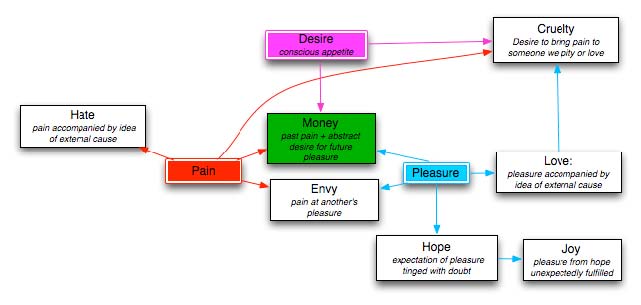
Money, Desire, Pleasure, Pain: Spinoza and Derman

In a thoughtful and provocative little essay, Emanuel Derman reads financial markets through the lens of Spinoza's moral geometry of the Good.  In "Money, Desire, Pleasure, Pain," Derman (who is Professor of Financial Engineering at Columbia, and a principal in Prisma Capital Partners) shows how money triangulates with Spinoza's "primitives" of desire, pain, and pleasure.  He defines "work" as pain in the service of desire.
http://edge.org/3rd_culture/derman09/images/1.jpg
Derman defines "money" as "past pain in the service of desire to survive as well as abstract future pleasure."  He writes that "Hope is the expectation of future pleasure tinged with doubt. Joy is simply the pleasure we experience when that doubtful expectation materializes. Envy is pain at another’s pleasure."

Tuesday, May 14, 2013

High-end Coffee and Maya Farmers in Guatemala


As with fine wine, provenance and terroir have become key elements of value in the world of high-end coffee. Like wine, coffee’s complex flavor profile is especially sensitive to climate, moisture, and soil conditions; and the highest priced coffees are varietals provenanced from single estates. In 2012, Korean buyers paid $500.50 a pound for a micro-lot of that year’s mocha varietal from the Guatemalan finca El Injerto (bought by YT Infinite, doing business as Brian's coffee). The entire lot was only 8 pounds, but the benchmark New York commodity price at the time was just about $170 per hundredweight, meaning that the El Injerto mocha sold for almost 300 times the going rate for washed arabicas.

I did not try this $500 coffee, but I have sampled a number of El Injerto’s more reasonable (if still pricey) alternatives. They produce my favorite coffee by far, with a deep, almost smoky, base and highlights of dark berries and citrus. Tastes vary, but by El Injerto holds its own with the very best. The owner of El Injerto, Arturo Aguirres, told me that until the late 1970s, they transported all of their coffee by mule, as they were no passable roads, and they he continued to plant the high altitude exotic varietals (Mocha, Pacamara, Maroquipe) even when they were not selling, because they were good coffees and he took pride in his coffee production. When others were switching their land to rubber and palm trees, Aguirres held out. And now it is paying off with the premiums his specialty coffees command. (See also Allison Aubrey's NPR piece on Journey of a Specialty Coffee Bean from Cherry to Cup.)

Are his coffees worth $6.60 a cup wholesale (and FOB Huehuetenango, Guatemala)? If it is what the market will bear, one could argue, then it seems that they must be. "Objective" quality (by established tasting standards) and market scarcity play an important role, but we cannot discount the symbolic values at play: the relative positioning of conspicuous consumption; the imagined, personal relationship with a producer (and his inspiring story); and underwriting it all, the cultural and market shift among the global affluent toward artisanal and singular products.  Yesterday, the NY Times reports on the consumption side of such coffees at high-end retailers such as Stumptown and Intelligensia

Throughout the twentieth century, coffee production in Guatemala was a highly concentrated industry composed of a small number of very large producers. These cafetaleros operated privately owned plantations (fincas) and depended on temporary, migrant labor to deliver what had become a high volume, low cost commodity product. The large producers traded with equally large and concentrated exporters and roasters who then completed the global value chain; this was the coffee that found its way into cups around the world as Folgers, Maxwell House, and hundreds of other brands. In the largely Maya highland communities where labor was recruited, working on coffee fincas was, and is, seen as employment of last resort because of the low wages and harsh conditions.

Today, we find a large number of former coffee laborers and subsistence farmers supporting their families by growing and selling their own coffee. The rapidly proliferating number of small producers—at least 50,000 new growers over the last 20 years, doubling the number of producers in Guatemala—has significantly altered the face of Guatemalan coffee. In the western highlands, the vast majority of these new producers are indigenous. They are cultivating increasingly differentiated varieties of high quality coffee on their own small parcels of land using family labor, and increasingly hiring day workers; a majority process and sell their coffee through a cooperative. Their production is sometimes sold as domain-specific varietals directly to small and medium sized roasters around the world rather than disappearing in vast, undifferentiated lots of commodity.

In a recent study, Bart Victor and I look at how coffee plays into the desires of Maya farmers for a better life.  Aguirres is not typical of the group—a ladino, relatively affluent, a third generation coffee farmer—but the prices his provenanced coffee commands dramatically illustrate the high end of this new market, and the potential for other farmers. El Injerto operates at the very upper end of the market, but the demand for quality and provenance has driven up prices for all of the high altitude Guatemalan producers, most of whom are today relatively smallholding Maya farmers.

There is dignity, many of these farmers told us, in working one’s own land, being one’s own boss, and they see coffee as a potentially lucrative way to keep their own production and be finically independent. They view seasonal plantation labor as a form of dependency, wrought with the hardships of being separated from one’s family, that they want to avoid if at all possible. They also prefer to hold wealth in land, and see coffee production as a way of expanding land holdings (or first time buying). The farmers we interviewed overwhelmingly want to get ahead, to achieve algo más in their lives, to see their children flourish, and they see coffee as a partial route to that. See Jennifer Johnston's piece on Consumer taste for high altitude beans shifts opportunity to small farmers.


We did our study in 2011, right after the March 31 peak New York C price of $298.93 (per hundredweight); two years later it has fallen to $135.43 (see price chart below).  At the same time the Coffee Rust fungus threatens large portions of Guatemalan production (estimates range from a drop of 15% to as high as 50% next year).  Price drops and coffee rust are certainly hitting the new entrant smallholders the hardest, and Bart and I hope to do follow up studies over the next year to see what impact this has had and farmers' livelihoods.

Tuesday, May 7, 2013

Economics and Anthropology: Stated Preferences, Dignity, and Pleasure

Noted economist Daniel McFadden makes a radical call for his field to pay more attention to the insights of anthropology and other disciplines in his NBER Working Paper "The New Science of Pleasure."  Summing up lots of recent research, McFadden claims that economics needs to look other fields not just to explain irrational anomalies, but to consider that complex subjects are the norm.  As The Economist puts it, "Homo economicus, not his fallible counterpart, is the oddity."

McFadden is on comfortable disciplinary ground in arguing for the inclusion of insights from behavior economics and psychology--the endowment effect, hyperbolic discounting, and other such cognitive quirks have been well documented by Daniel Kahneman and others.

Where McFadden pushes the envelope is his call for incorporating anthropological and social science perspectives into economic modeling to understand the role of identity, social relations, and persuasion in decision making.

The manuscript I just finished (The Good Life: Aspiration, Dignity, and the Anthropology of Wellbeing) echoes a number of McFadden's observations, which I take to be an encouraging sign of the changing zeitgeist.  For example, while economists have long privileged revealed preferences (observable behavior) we need to take more seriously stated preferences (what folks say they want to do).  Revealed preferences are taken by economists to be more real: it is thought that when the rubber hits the road and the cash changes hands, one reveals one’s true preferences.  At the same time, a laser focus on revealed preferences discounts the importance of the cultural—the fact that choices are delimited, as in the all too common scenario we are faced with on the grocery store aisle and in the voting booth of choosing between the lesser of evils. Stated preferences, in not being bound to the immediate here-and-now, often take a longer-range view of overall preferences and ideals. Stated preferences are more likely to be concerned with non-material values; these are given more weight in the long term project of one’s life, one’s overall wellbeing. Often they are connected to identity.    

In my book, I also focus on the role of dignity and fairness, which The Economist also neatly highlights in their review of McFadden's paper: "Dignity is not something mainstream economics has much truck with.  But creating a sense of dignity turns out to be a powerful way of affecting decisions."  It is also a key element of wellbeing. 

Tuesday, April 2, 2013

Future Virtues and Current Choices

What we say we want is not always what we do, but that doesn't mean that we are always lying or deceiving ourselves (although we may do that too).  What we say is often what we really want, even if we sometimes stumble in practicing what we preach.  That might seem self-evident to therapists and priests, but it poses a big problem for economists and policy makers (whose models usually assume that we reveal our true preferences in deed and not word).  As I argue, our stated preferences may be harder to model but, in looking to the future, also tend to be more pro-social, more concerned with the common good.

It turns out there is some experimental proof for this idea.  Tal Eyal, Nira Liberman, and Yaacov Trope have devised studies that suggest that "people judge immoral acts as more offensive and moral acts as more virtuous when the acts are psychologically distant than near. This is because people construe more distant situations in terms of moral principles, rather than attenuating situation-specific considerations" (from a 2008 article "Judging near and distant virtue and vice" in the Journal of Experimental Social Psychology).  

This has implications not only in the rarefied world of virtue studies.  It turns out that we act in ways counter to what we say we want all the time in little ways. The NY Times Sunday reported on research by Alessandro Acquisti that shows that people say they place a high value on the privacy of their personal data, but are quick to give that up in the moment when filling out online forms.

We sometimes need a little help to do what we want to do; paradoxically, sometimes regulation and restrictions can help us be more free to be who we want to be.