
Tuesday, November 6, 2018

Thursday, November 1, 2018

Friday, March 30, 2018
Thursday, December 28, 2017
Economy, Happiness, and the Good Life: An Interview with Edward F. Fischer
 |
| GB. England. New Brighton. From ‘The Last Resort,’ 1983-85, Martin Parr. |
KR: What do you understand by the notion ‘the good life’?
Edward F Fischer: I see you are starting off with the trick questions. A large part of the attraction of the phrase is precisely its semantic slipperiness and strategic ambiguity. We may all agree . . . continue at http://kingsreview.co.uk/articles/economy-happiness-good-life-interview-edward-f-fischer/
Tuesday, October 18, 2016
Eating Identity: Nourishment and the Cultural Contexts of Food

We eat for nourishment, but food is about much more than nutrition. What we eat is meaningful, and food is an especially intimate area of daily life, tightly linked to our conceptions of self. Think about your own food preferences: a nostalgic meal from your childhood, a treat you indulge yourself with on special occasions, a religious sanction against certain foods. In these ways, food is not only at the heart of our material subsistence, it is at the core of our identity as well, deeply associated with family, hearth, home, and community. We are what we eat, conceptually as well as biologically.
Understanding this becomes especially important when we look at nutrition from a public health perspective. In a situation that would have been unimaginable for most of human history, over-nutrition has become one of the biggest problems for health and chronic diseases in many parts of Europe and the U.S., eclipsing smoking as public health enemy #1. The chronic and non-communicable diseases that are the big burden these days (heart disease, cancer, diabetes, stroke) are often connected to diet.
The WHO’s Health 2020 report advocates people-centered approaches to public health, looking at both the whole person and the whole society. This is especially relevant for nutrition because it is so connected to different aspects of life, from our cultural and idiosyncratic preferences to state subsidies and agricultural policy.
Poor nutrition is not just an over-abundance of macro-nutrients or a deficiency of micro-nutrients: it is based on cultural traditions and personal histories; the natural environment and geographies of inclusion and exclusion; about large food corporations and grocery store marketing as well public policy and regulations. This is to say that both structural conditions and cultural practices affect nutritional choices.
Thinking of food and identity, what comes to mind first might be kosher or halal cuisines, or perhaps vegetarian or vegan preferences. These are certainly important aspects of religious and social identity, but the link works at a much more mundane levels as well. Our quotidian food choices reflect our preferences and values, and identity: eating organic (or not), eating fast food (or not), liking broccoli (or not), and so on.
Since food is so integral to identity, it is tricky to tinker with. And food choices not only reflect identity, but identities can become literally embodied through eating. For example, many Maya people in Guatemala claim not feel full unless they eat corn tortillas (often a dozen or more with every meal); I have heard Germans claim the same feeling and physical craving for black bread.
Eating is also usually a group activity, and as such a primary site for socialization, family binding, and group identity reinforcement. Yet nutritional recommendations often focus just on the individual. And since individual choices affect others, change cannot happen with just the individual, it would involve the whole family.
And just as eating is a group activity, also provisioning is often an expression of love and caring. Anthropologist Daniel Miller has show how food treats are especially important in this regard: choosing for significant others what they might want. Miller shows that grocery shopping, far from the hedonistic indulgence that the term “consumerism” invokes, is more about provisioning for one’s family, expressing one’s concerns for loved ones.
Packaged and processed foods are a big contributor to poor nutrition, and so are deservedly the target of ire among nutritionists and public health advocates. A number of efforts to impose a “soda tax” have been tried around the world; in Mexico it has had a dramatic and measurably impact in just a few years. All the same, we should also recognize that such foods are one of the few affordable luxuries for poor families, a way to demonstrate their love for their children when they cannot give them much else. It is well and good to try to curb snack food consumption, but keep in mind that it may be more than a snack that has to be changed.
Finally, when we talk about the health impacts of nutrition, we often reduce eating down to certain numbers. My colleague Emily Yates-Doerr, in her book the Weight of Obesity, calls this the metrification of diets: the number of calories and grams of fat, the percentages of daily allowances for vitamins and minerals. This metrification reduces the richness of eating and the sociality around it to these metrics of macro- and micro-nutrients. Many of us have become accustomed to this way of thinking about food, reading labels on the fly in the supermarket. Food and eating is about love and identity as much as calories, but how do we translate “love” into grams or ounces?
Just because something is supposed to be “good for you” is often not enough to change behavior. Diet and food choices need to be looked at holistically, as part of broader lifeways and family and social networks. Labeling regimes can inform consumer decisions and move the market, and soda taxes and other nudges can make a difference, but ultimately public health programs working on nutrition need to engage people through their customs and beliefs rather than work at odds with them.
In an innovative approach, Brazil has adopted what they call “food-based” dietary guidelines that seek to build on cultural norms and preferences rather than fight them. Rather than giving percentages recommended for different foodstuffs (as with the traditional food pyramid), Brazil adopted 10 broad principles and illustrate them in public service ads in terms of a plate prepared for a typical meal.
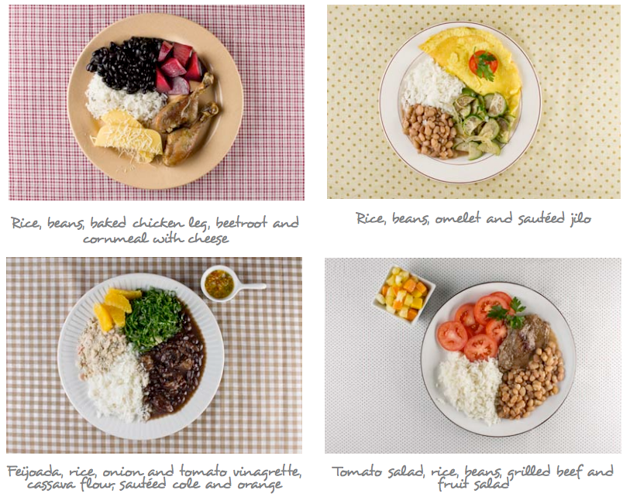
- Make natural or minimally processed foods the basis of your diet
- Use oils, fats, salt, and sugar in small amounts
- Limit consumption of processed foods
- Avoid consumption of ultra-processed foods
- Eat regularly, deliberately, and with others
- Shop in places that offer a variety of natural or minimally processed foods
- Develop, exercise and share cooking skills
- Plan your time to make food and eating important in your life
- Out of home, prefer places that serve freshly made meals
- Be wary of food advertising and marketing
Sunday, August 21, 2016
Third Wave Coffee and the Formation of Taste (and Value)
-->
 In 2015 the SCAA unveiled a new flavor chart for specialty
coffee. Working with researchers at UC Davis and Kansas State, the Coffee
Taster’s Flavor Wheel offers a lexicon of coffee terms coming from “the
frontiers of sensory science methods and analyses.” They described the process
using technical language (“an Agglomerative Hierarchical Cluster (AHC) analysis
was performed on the results from the sorting exercise to group the flavor
attributes into different categories (or clusters) represented visually by a
dendrogram”) (Sage 2016).
In 2015 the SCAA unveiled a new flavor chart for specialty
coffee. Working with researchers at UC Davis and Kansas State, the Coffee
Taster’s Flavor Wheel offers a lexicon of coffee terms coming from “the
frontiers of sensory science methods and analyses.” They described the process
using technical language (“an Agglomerative Hierarchical Cluster (AHC) analysis
was performed on the results from the sorting exercise to group the flavor
attributes into different categories (or clusters) represented visually by a
dendrogram”) (Sage 2016).
“Orange blossom, white tea, syrupy”
“Grapefruit, spicy pepper, olive oil”
“Chocolate, red berries, roasted barley”
The language used to talk about new high-end coffee comes
straight out of the wine world, with exotic and evocative descriptors and even
a 0-100 grading scale (à la Robert Parker). Scores above 80 mark “specialty”
coffee (such as would be served at Starbucks) and scores in the high 80s and
breaking 90 place beans in the rarefied world of Third Wave coffees that retail
for $5, $6, $7 a cup and more than $25 a pound for roasted beans (although
usually sold in 12oz, or increasingly 6oz, packages to both stress the limited
supply and make the price tag slight less eye-popping).
Virtually all high-end coffees are of the species Arabica;
among Arabicas there are a range of different varieties. A growing number of
exclusive lots of green coffee have sold for more than $100 a pound, a ceiling
first broken in 2007 by the storied Geisha varietal from Hacienda La Esmeralda
in Panama. In 2012, a Mocca (a heirloom varietal originally from Yemen) grown
by the Finca El Injerto in Guatemala sold for $500.50 a pound, still a record.
(Meanwhile, the commodity price for quality washed Arabica, known as the New
York C price, has fluctuated between $1.13 and $1.46 over the first 8 months of
2016)
Are these coffees worth that much? People often ask me this
when I talk about Third Wave coffee. If you haven’t tried one yet, it is a
different experience than either the office kitchen’s K-cup or even a solid cup
of coffee from most neighborhood coffee shops. A whole range of subtle flavors
come out in the clean, smooth, balanced cup profile; sugar and milk are,
naturally, verboten.
Yes, but are they worth the high price? It depends on how we
value them. In high-end markets that move toward singularity (limited edition
prints, that particular Bordeaux vintage, the 2012 El Injerto Mocha), normal
market forces of supply and demand don’t apply. Which leads us to consider what
constitutes value for such non-commodities and how do we put a price on that.
Objective quality (by established tasting standards and
conventions) and market scarcity play an important role, but we cannot discount
the symbolic values at play: the relative positioning of conspicuous
consumption; the imagined, personal relationship with a producer; and
underwriting it all, the cultural and market shift among the global affluent
toward artisanal and singular products. The language used to talk about Third
Wave coffee borrows heavily from fine wine, ideas of terroir, and the artisanal
food movement. And this provenance, these narratives, are key to its value.
Three Waves
The first wave of coffee consumption lasted from the late
nineteenth century up through the 1960s, marked by the spread of commodity
coffee and the rise of Folgers, Maxwell House, and all the other familiar
grocery store brands.
The second wave started in the 1960s in the U.S. with Peet’s
in San Francisco and Zabar’s in New York, and culminating in the spread of
Starbucks to every nook and cranny of the country, and increasingly the world.
Anthropologist William Roseberry describes this as a shift from coffee as being
the beverage of capitalism (coffee and sugar serving as great proletarian
hunger killers, as Sidney Mintz has pointed out) to being a beverage of
postmodernity (an outlet for performing identity and difference).
The Third Wave coffees take this to the next, artisanal
infused, level. Coming out of coffee shops in Portland, Brooklyn, San
Francisco, Nashville, Washington, Philadelphia, and other cities, Third Wave
has both hipster and foodie associations; it is sold by online retailers such
as Stumptown, Intelligentsia, and Blue Bottle.
Creating Taste and Value
The Specialty Coffee Association of America (SCAA, the trade
group for specialty and Third Wave coffee) goes to great lengths to bolster the
scientific credibility of its classifications and tasting protocols. The more
objective they seem, they more they can impart the power of authenticity
(discovering something rather than constructing it).
The SCAA-associated Coffee Quality Institute certifies
coffee cuppers with its Q Grader certification, with applicants having to pass
five “triangulation cuppings” to differentiate a total of 90 distinct coffees.
A Roast magazine article on the
allure of triangulated cupping, observes that even a novice will quickly learn
to distinguish coffees from different world regions, then so after by country.
For example, “a Latin American coffee is going to taste different than an
African coffee,” and tasting them side by side reveals the differences. “Put an
Ethiopia Harrar into two cups and Sumatra Mandheling in one cup, and you will
know the difference,” the article claims. Or, at least, you will learn the
differences in going through a cupping protocol. One Portland roaster loved
“the earthiness of the Sumatra” and another noted that Central American coffees
are known for an exceptionally clean acidity (Allen 2010: 58).
 In 2015 the SCAA unveiled a new flavor chart for specialty
coffee. Working with researchers at UC Davis and Kansas State, the Coffee
Taster’s Flavor Wheel offers a lexicon of coffee terms coming from “the
frontiers of sensory science methods and analyses.” They described the process
using technical language (“an Agglomerative Hierarchical Cluster (AHC) analysis
was performed on the results from the sorting exercise to group the flavor
attributes into different categories (or clusters) represented visually by a
dendrogram”) (Sage 2016).
In 2015 the SCAA unveiled a new flavor chart for specialty
coffee. Working with researchers at UC Davis and Kansas State, the Coffee
Taster’s Flavor Wheel offers a lexicon of coffee terms coming from “the
frontiers of sensory science methods and analyses.” They described the process
using technical language (“an Agglomerative Hierarchical Cluster (AHC) analysis
was performed on the results from the sorting exercise to group the flavor
attributes into different categories (or clusters) represented visually by a
dendrogram”) (Sage 2016).
The flavor wheel ranges from Chamomile, Rose and Jasmine to
Vegetative and Herblike to Petroleum, Skunk, and Pipe Tobacco.
In order to calibrate such flavors, the accompaning guide
gives references to ground a 0-15 scale of intensity. For example, one entry
reads:
BLACKBERRY: The sweet, dark, fruity,
floral, slightly sour, somewhat woody aromatic associated with blackberries
REFERENCE: Smucker’s
Blackberry Jam
INTENSITY: 5.5
PREPARATION: Serve
jam in a 1-ounce cup. Cover with a plastic lid.
Recently, among trendsetters there has been a shift in
preference away from the more traditional deep, creamy chocolate flavors (and
maple syrup, caramel, red wine) toward more floral and citrus notes.
The Cup of Excellence program has taken cupping
standardization to the next level, as my colleague Bradley Wilson has observed.
In Cup of Excellence competitions, each coffee will be blindly evaluated 5
times by different cuppers. Only coffees
that get consistently high scores advance in the competition, and out of
hundreds of entrants each country will have 25-35 ranking winning coffees that
are sold at a live internet auction.
Guatemala is ground zero for Third Wave coffee. This is due
in part to its unique geographic and climatic endowments. High altitude coffees
tend to command higher premiums, and Guatemala’s volcanic slopes and varied
microclimates create a range of subtle flavors. But it was also visionaries
such as Bill Hempstead, who as president and a director of the Guatemalan Coffee
Association (Anacafé), promoted the branding of regional cup profiles which has
led to the flourishing of single estate and micro-lot coffees.
Saturday, August 20, 2016
Broccoli, Anthropology, and the Humanities
Broccoli, Anthropology, and the Humanities: Caitlin Patton discusses how the work of Ted Fischer, an anthropologist focused on food culture, specifically the cultivation of broccoli in Guatemala, inspired her choice to study at Vanderbilt University.
Monday, August 1, 2016
Imagining the Future & Economic Fictions
“The tradition of all dead generations weighs like a nightmare
on the brains of the living,” Marx remarked in The Eighteenth Brumaire, and although we may all make our own
futures, we do not make them just as we please. For such reasons, we social
scientists tend to look to the past to explain the present, to show the particular historical trajectory that led things
to be the way the are. All the same, privileging the past can allow us to forget that
people in the present are not trying to (just) recreate yesterday, but have an
eye toward tomorrow and next year and the lives of their children and
grandchildren.
Unlike Marx’s vivid prose, today the dismal science (qua
science) often forgets about the human passions behind their numbers. In the
sterile statistical world of GDP and interest rates, it is easy to loose sight
of the hopes and dreams, the aspirations and fears—what Keynes termed our
“animal spirits”—and the individual lives behind all economic transactions.
In a remarkable new volume, Jens Beckert (Imagined Futures: Fictional Expectations and
Capitalist Dynamics) moves us toward conceptually linking the passions and
animal spirits of lived experience with a macro-understanding of the workings
of capitalism. He does this by focusing on the future, and the fictive
qualities of imagining the future that underwrite capitalist dynamics.
In this meticulously researched and engagingly written
volume, Beckert uncovers the role of imagined futures as a fundamental driver
of capitalism. It is the sort of observation that makes complete sense when you
hear it, but that has gone largely unremarked upon until now. He shows that the
future orientation of capitalism is based on competition and credit,
fundamental elements at the very core of the financial system. (I would add,
also the construction of desires, especially in late capitalist formations.)
The financial system is built on credit, and demands continual expansion and
continual returns. We are all in bad shape if growth stops, as our retirement
and much of our insurance depends on markets continuing to expand—not to
mention our subjective hopes and dreams.
Beckert makes the provocative point that a lot of what we
consider to be risk (and thus manageable, knowable, predictable) is actually
uncertainty. We make up stories about the future, and convince ourselves and
others that these are more or less likely (in a statistically predictable
manner). For example, investment in innovation requires collectively deciding
to believe in a fictional future. And, as with innovation, imaginaries can
create structures that make real the fictional expectations (186).
In the realm of consumption, Beckert identifies two key
types of symbolic value: (1) positional and (2) imaginative. Positional values
(first observed by Veblen) derive from the scarcity of a good and how many
others have it; rather than absolute material utility, the positional value of
a good is only given by its relation to other goods. With imaginative value, “a
good functions as a link between subject and her desired but intangible ideals”
(195). Imaginative value gets at what it means to the person herself, more than
just positional/status importance. With imaginative value, a good embodies
something transcendent.
Berkert’s new book is exhilarating, opening up new
possibilities for thinking about (and acting on) the market. It gives us a way
to insert the social and the cultural back into the fundamental mechanics of
capitalism, from wince it has long been banished.
Jens Beckert’s Imagined
Futures: Fictional Expectations and Capitalist Dynamics. 2016, Harvard U Press.
Friday, November 13, 2015
Q&A: Ted Fischer of Vanderbilt | Nashville Post
Read the Nashville Post's Q&A: Ted Fischer of Vanderbilt on Social Entrepreneurship and Mani+
Ted Fischer is professor of anthropology and director of the Center for Latin American Studies at Vanderbilt University. Over a five-year period, he teamed with Steve Moore (head of Middle Tennessee-based Shalom Foundation) and multiple VU students on a malnutrition-oriented and social enterprise effort called NutriPlus, which produces the supplement, Mani+.
The supplement (a fortified nut paste that provides calories, protein, fat, vitamins and minerals essential to brain development in babies and toddlers) is used to specifically address the nutritional deficiencies seen in Central American children. It is the first ready-to-use supplementary Food (RUSF) to be both locally produced and locally sourced in Guatemala City, Guatemala, creating local jobs and supporting local farmers.
The new facility (read more here) opened on Sept. 23 and will eventually mass produce Mani+. Eventually, Fischer and Moore hope to produce 25 tons of Mani+ a month, reaching about 25,000 children.
Post Managing Editor William Williams recently chatted with Fischer regarding the effort.http://nashvillepost.com/blogs/postbusiness/2015/10/19/qa_ted_fischer_of_vanderbilt
Ted Fischer is professor of anthropology and director of the Center for Latin American Studies at Vanderbilt University. Over a five-year period, he teamed with Steve Moore (head of Middle Tennessee-based Shalom Foundation) and multiple VU students on a malnutrition-oriented and social enterprise effort called NutriPlus, which produces the supplement, Mani+.
The supplement (a fortified nut paste that provides calories, protein, fat, vitamins and minerals essential to brain development in babies and toddlers) is used to specifically address the nutritional deficiencies seen in Central American children. It is the first ready-to-use supplementary Food (RUSF) to be both locally produced and locally sourced in Guatemala City, Guatemala, creating local jobs and supporting local farmers.
The new facility (read more here) opened on Sept. 23 and will eventually mass produce Mani+. Eventually, Fischer and Moore hope to produce 25 tons of Mani+ a month, reaching about 25,000 children.
Post Managing Editor William Williams recently chatted with Fischer regarding the effort.http://nashvillepost.com/blogs/postbusiness/2015/10/19/qa_ted_fischer_of_vanderbilt
Thursday, October 1, 2015
Friday, September 4, 2015
Health, Culture, and Wellbeing: Beyond Seeing Culture as Obstacle
The World Health Organization (WHO) defines health as “a complete state of physical, mental and social well-being, and not merely the absence of disease or infirmity.” And yet, for much of its history, it has (understandably) focused on eradicating disease and infirmity. There is a move afoot with the WHO to focus more on wellbeing as broadly conceived in its charter. Nils Fietje and colleagues at WHO-Europe have been looking lately at “Cultural Determinants of Health,” a project I have advised.
While there is a growing understanding that “culture” plays a crucial role in health and development, the concept as it is invoked generally relies on very traditional definitions. Common definitions of culture in public health understand it to be “shared values, beliefs, and practices.” Note that here “culture” is used as a noun, denoting bounded groups defined by lists of traits.
But we should see cultural forms as opportunities, not as obstacles, to health
A human-centered approach to health and wellbeing, should adopt contemporary understandings of culture as dynamic, future oriented, and driven by agency. We in anthropology now see culture as much more of a fluid process, a process rather than a thing. Cultural actors are always improvising, actively creating meaning out of the resources at hand.
We have also traditionally put too much emphasis on the historical determinants of culture and adherence to tradition. My view is that we should think of cultural orientations not just as not endowments but as future-oriented desires. Arjun Appadurai defines culture as “a dialogue between aspiration and sedimented traditions.”
In this view, culture opens the door for new opportunities for engaging communities and understandings of well-being.
The full report in English and Russian is at: http://www.euro.who.int/en/data-and-evidence/cultural-contexts-of-health/beyond-bias-exploring-the-cultural-contexts-of-health-and-well-being-measurement
While there is a growing understanding that “culture” plays a crucial role in health and development, the concept as it is invoked generally relies on very traditional definitions. Common definitions of culture in public health understand it to be “shared values, beliefs, and practices.” Note that here “culture” is used as a noun, denoting bounded groups defined by lists of traits.
What is missing from such definitions is the human element: real human beings constructing their lives in active and dynamic ways. The traditional static definition (the most common one deployed in public health contexts today) usually portrays culture as an obstacle to health.
But we should see cultural forms as opportunities, not as obstacles, to health
A human-centered approach to health and wellbeing, should adopt contemporary understandings of culture as dynamic, future oriented, and driven by agency. We in anthropology now see culture as much more of a fluid process, a process rather than a thing. Cultural actors are always improvising, actively creating meaning out of the resources at hand.
We have also traditionally put too much emphasis on the historical determinants of culture and adherence to tradition. My view is that we should think of cultural orientations not just as not endowments but as future-oriented desires. Arjun Appadurai defines culture as “a dialogue between aspiration and sedimented traditions.”
In this view, culture opens the door for new opportunities for engaging communities and understandings of well-being.
The full report in English and Russian is at: http://www.euro.who.int/en/data-and-evidence/cultural-contexts-of-health/beyond-bias-exploring-the-cultural-contexts-of-health-and-well-being-measurement
Wednesday, July 1, 2015
Voting for Our Better Selves; and Rules to Flourish By
Mike Pesca, in one of his artful spiels on The Gist podcast, punctures the conventional wisdom that we Americans want folksy presidential candidates, that we yearn for a leader just like us, someone we can relate to, imagine having a beer with. While we do like candidates to be down-to-earth (perhaps echoes of our anti-monarchical national origins), Pesca convincingly argues that what we really want is not a leader like us but one who is like our better selves -- not someone who plays to our fears and prejudices but someone who can embody our virtuous aspirations.
Indeed. As I argue in The Good Life: Aspiration, Dignity, and the Anthropology of Wellbeing, we aspire to be certain sorts of people -- a key part of our identity is not just who we are, but who we want to be. Our aspirations reflect certain sorts of values, what matters most to us in the big scheme of things. These aspirations, and our better selves, can be undermined by short-term gains and hedonic pleasures. And so we need leaders to remind us of our better selves and guide us down the often more arduous path of long-term personal and collective fulfillment.
For these same reasons, we also need rules to hep us be our better selves. A recent RadioLab episode (Nazi Summer Camp) looked at how the U.S. treated the 500,000 or so German and Japanese POWs in U.S. camps. It turns out we treated them exceedingly well, fully following the letter and spirit of the Geneva Convention, even when we saw that the Japanese and Germans were not so scrupulous in their adherence. Significantly, we treated the U.S. citizens of Japanese descent much worse at the internment camps. As U.S. citizens, paradoxically, there were no international rules to govern their treatment, and the country showed it worse side. Similar examples of how rules can help us be the sort of people we say we want to be can be found in Lynn Stout's excellent book Cultivating Conscience and in my book The Good Life.
Indeed. As I argue in The Good Life: Aspiration, Dignity, and the Anthropology of Wellbeing, we aspire to be certain sorts of people -- a key part of our identity is not just who we are, but who we want to be. Our aspirations reflect certain sorts of values, what matters most to us in the big scheme of things. These aspirations, and our better selves, can be undermined by short-term gains and hedonic pleasures. And so we need leaders to remind us of our better selves and guide us down the often more arduous path of long-term personal and collective fulfillment.
For these same reasons, we also need rules to hep us be our better selves. A recent RadioLab episode (Nazi Summer Camp) looked at how the U.S. treated the 500,000 or so German and Japanese POWs in U.S. camps. It turns out we treated them exceedingly well, fully following the letter and spirit of the Geneva Convention, even when we saw that the Japanese and Germans were not so scrupulous in their adherence. Significantly, we treated the U.S. citizens of Japanese descent much worse at the internment camps. As U.S. citizens, paradoxically, there were no international rules to govern their treatment, and the country showed it worse side. Similar examples of how rules can help us be the sort of people we say we want to be can be found in Lynn Stout's excellent book Cultivating Conscience and in my book The Good Life.
Wednesday, May 27, 2015
Key Words for Understanding the Germany Economy
We often speak of "capitalism" or "the market" as if they are singular things. We are comfortable talking about how the economy is doing, if "it" is up or down today. And in this globalized world it would seem that it makes little difference if the "it" we refer to is in Berlin or London or New York or Shanghai.
Yet there are huge differences in the varieties of capitalism practiced in these places. Looking beyond the big boards, we find systems wrapped up in their own histories and politics and moral values.
For example, The Economist recently had an analysis of the huge influence German's distinct system of "ordoliberalism" has had in defining the political economy of post-crisis Europe.
To understand the German form of capitalism, it is helpful to learn a few key words:
Sparpolitik: what we term "austerity," the Germans refer to in a much more positive light as "savings policy," invoking wise stewardship more than miserly witholding. So when the Germans are negotiating with the Greeks these days about getting out of debt, they see Sparpolitik as a value that should be desired as much as an austerity to be endured.
Ordoliberalism: it stumbles over the tongue the way a good German word should. It takes inspiration from the liberalism of the Austrian School in its heyday, with a value on personal liberty and a skepticism of central planning. That the liberal part. But the “ordo” part is, as you would suspect, an “ordered” (i.e. regulated) liberalism, largely based on the principles of Mitbestimmung.
Mitbestimmung: ("co-determination") is a system of labor relations that treats labor as stakeholders alongside capital and management; built around "works councils," tiered organizations of employee representatives (blue and white collar) elected by their peers; through works councils labor holds (by law) 50% of corporate supervisory board seats.
Mittelstand businesses, small to medium sized enterprises that are often family or otherwise privately owned, and comprise the export engine of the German economy. Many specialize in high value, high quality engineered products. The Mittlestand have a reputation for honoring a commitment to their employees, embracing the German system of stakeholding and co-determination.
Kurzarbeit ("short work") program provides government subsidies to companies to keep their employees on the payroll but reducing their working hours; in the financial crisis this allowed companies to keep workers, reducing their productivity but allowing them to keep the talent they have built up, to save it for better times.
Solidarität ("Solidarity") is is a value extolled by the political left and right in Germany; the civic virtue that we are all in this together, and that living in a society together requires certain sacrifices for the common good.
Schuld: debt -- and guilt.
Haftung: liability -- and responsibility
Yet there are huge differences in the varieties of capitalism practiced in these places. Looking beyond the big boards, we find systems wrapped up in their own histories and politics and moral values.
For example, The Economist recently had an analysis of the huge influence German's distinct system of "ordoliberalism" has had in defining the political economy of post-crisis Europe.
To understand the German form of capitalism, it is helpful to learn a few key words:
Sparpolitik: what we term "austerity," the Germans refer to in a much more positive light as "savings policy," invoking wise stewardship more than miserly witholding. So when the Germans are negotiating with the Greeks these days about getting out of debt, they see Sparpolitik as a value that should be desired as much as an austerity to be endured.
Ordoliberalism: it stumbles over the tongue the way a good German word should. It takes inspiration from the liberalism of the Austrian School in its heyday, with a value on personal liberty and a skepticism of central planning. That the liberal part. But the “ordo” part is, as you would suspect, an “ordered” (i.e. regulated) liberalism, largely based on the principles of Mitbestimmung.
Mitbestimmung: ("co-determination") is a system of labor relations that treats labor as stakeholders alongside capital and management; built around "works councils," tiered organizations of employee representatives (blue and white collar) elected by their peers; through works councils labor holds (by law) 50% of corporate supervisory board seats.
Mittelstand businesses, small to medium sized enterprises that are often family or otherwise privately owned, and comprise the export engine of the German economy. Many specialize in high value, high quality engineered products. The Mittlestand have a reputation for honoring a commitment to their employees, embracing the German system of stakeholding and co-determination.
Kurzarbeit ("short work") program provides government subsidies to companies to keep their employees on the payroll but reducing their working hours; in the financial crisis this allowed companies to keep workers, reducing their productivity but allowing them to keep the talent they have built up, to save it for better times.
Solidarität ("Solidarity") is is a value extolled by the political left and right in Germany; the civic virtue that we are all in this together, and that living in a society together requires certain sacrifices for the common good.
Schuld: debt -- and guilt.
Haftung: liability -- and responsibility
Wednesday, May 13, 2015
A Guatemalan Spring?
 |
| Photo: @PrensaComunitar |
Francisco Goldman, in his masterful book The Art of Political Murder, shows how political power in Guatemala acts with such impunity as to border the magical realism of Latin American fiction. (Goldman examines the 1998 murder of Bishop Juan Gerardi, just days after the commission he led released a scathing report on military culpability in Guatemala's civil war atrocities.)
Even more bizarre was the 2009 murder of lawyer Rodrigo Rosenberg (see David Grann's brilliant dissection of the case in the New Yorker). Days before his assassination, Rosenberg had recorded a video predicting his death and accusing the then-President and First Lady of orchestrating it. Protestors were on the streets then, too, although in fewer numbers. And, in the end, it turned out that Rosenberg had commissioned his own assassination (in order to shine a light on the corruption coming from the President's office and family).
Everyone agrees that corruption is a major problem. Indeed, the country considered itself so corrupt that it agreed to charter the International Commission Against Impunity in Guatemala (CICIG) in 2007. CICIG, with UN backing, is a body of international jurists authorized to conduct investigations and build cases for charges filed in Guatemalan courts.
CICIG's explicit goal is to dismantle the parallel power structures of organized crime, narco-traffickers, and former military fraternities. CICIG has been instrumental in the arrests of a former president (money laundering), two national police chiefs (corruption), the head of the anti-narcotics agency (drug trafficking), and number of other well-placed officials.
CICIG's explicit goal is to dismantle the parallel power structures of organized crime, narco-traffickers, and former military fraternities. CICIG has been instrumental in the arrests of a former president (money laundering), two national police chiefs (corruption), the head of the anti-narcotics agency (drug trafficking), and number of other well-placed officials.
Its latest investigation resulted in the current (2015) protests.
The scandal, known as "La Linea" (see Guatemalan Chimney's excellent overview here) emerged when CICIG announced 47 arrest orders for a massive tax evasion scheme, including superintendent of SAT (equivalent of our IRS commissioner) and the Vice-president’s personal secretary (named as the ring leader of the organization). The group has a special phone number (la linea) to avoid duties and a shell corporation to accept the estimated $130 million in payments for services.
The scandal, known as "La Linea" (see Guatemalan Chimney's excellent overview here) emerged when CICIG announced 47 arrest orders for a massive tax evasion scheme, including superintendent of SAT (equivalent of our IRS commissioner) and the Vice-president’s personal secretary (named as the ring leader of the organization). The group has a special phone number (la linea) to avoid duties and a shell corporation to accept the estimated $130 million in payments for services.
The Vice-president (Roxana Baldetti) and her secretary (Juan
Carlos Monzón) were in South Korea at the time of the arrests, and Monzón refused to return to Guatemala. Wire tap transcripts make numerous references to an unnamed co-conspirator,
referred to as “La Número 2,” “La Senora” or “La ‘R’,” widely believed to be Baldetti.
On April 25th massive protests filled the Central Plaza and downtown of Guatemala City, and have continued weekly. Organized through social media, these seem to be largely acephalous and non-violent. See my thoughts in Jared Goyette's great PRI piece (http://www.pri.org/stories/2015-05-02/guatemalan-spring-youth-driven-protests-demand-president-s-resignation).
On May 8th, to the surprise of many jaded observers, including your correspondent, the normal wall of impunity crumbled, and Baldetti was forced to resign. Presidential elections are later this year; if a clean candidate could capture the energy of these protests, this could be a watershed moment for Guatemala. A new Spring.
Thursday, April 30, 2015
Friday, April 17, 2015
The Good Life: What Really Matters | Health and Wellness | Vanderbilt University
LISTEN TO THE ENTIRE INTERVIEW HERE ON WELLCASTS
Ted Fischer, Ph.D., Professor of Anthropology and Director of the Center for Latin American Studies, discusses the “Good Life,” and why it is important to focus on what matters most.
Janet McCutchen: Welcome to this edition of the Vanderbilt University Health and Wellness Wellcast. I am Janet McCutchen with Work/Life Connections. Today, I have the pleasure of speaking with Dr. Ted Fischer who is Professor of Anthropology and the Director of Center for Latin American Studies. He also is an adviser to the World Health Organization on well-being. Dr. Fischer, thank you for participating in our Wellcast.
Dr. Ted Fischer: I am so happy to be here.
Janet McCutchen: I wanted to begin by asking you, I think, an important question as it relates to our particular department, Work/Life Connections, as part of Occupational Health. We are designed to help all of Vanderbilt’s faculty, physicians, and staff reach a better level of well-being. What is the key finding of your cross-cultural research on how to be well?
Dr. Ted Fischer: Well, that is a great question, and yes, because we so often think about well-being as tied to certain things. Income is a big one. “If I made a little bit more money, boy, I could be happier.” Health is another, and these are all important things. Income is important, health is certainly important, physical security is important, relationships are important, but beyond that, it is having a larger purpose in life that we are committed to, having a balance between these things, between our work life and our family life, relationships. Investing time in relationships turns out to be really, really important to our sense of well-being. So, well-being is more than just not being ill. It is being well in all of these aspects of one’s life, one’s physical health, one’s mental health, one’s social standing.
Janet McCutchen: Well, we know that you have done a lot of cross-cultural research, and you have an excellent book, one of several, that is out now entitled “The Good Life.” What is the good life and
how can we learn to focus on what matters versus just looking at well-being from a quantitative perspective, right? I live in such and such dollar house. I need to lose X amount of pounds. Help us define that from that cross-cultural perspective.
Dr. Ted Fischer: Yeah, and again a great question because we do so often attach our hopes and dreams to these things, a little bigger house, a little nicer car, and yet often, those are not the most
important things, they are not. In fact, I can decide they are not the most important things to our sense of well-being. We do find the cross culture is a sense of dignity and fairness that I am treated with dignity. In my workplace, I am free from discrimination, but even more than that sort of absence of negative, free from discrimination, people respect what I do. Whatever it may be, a sense of dignity is really important and a sense of being committed to a larger purpose in our lives, and that can be something very specific of “I am going to master this craft the best that I can be; if I am a knitter, I am going to be the best, I am going to make this design, just the best way that I can;
or, and this is nice for those of us working in either the medical side or the university side, we are part of the larger project, right? We are making people better, we are building future citizens and leaders,
and so there is something bigger beyond just my weekly or monthly paycheck that motivates me.
Janet McCutchen: And you found those results as far afield from Germany all the way to the Mayan culture in Guatemala. Tell me a little bit about that experience. What did you discover?
Dr. Ted Fischer: That’s right, and so part of the idea behind this research was, “Okay, we all want to live the good life, but we differ and sometimes violently on what the good life is and how best to
achieve it. What is the path to the good life?” So, I said, “Well, let’s look at some really radically different places. The US for sure, but let’s look at Germany, another country, another wealthy country, another developed country, and see what they think about the good life, and let’s look at Guatemala, a poor country, a country inhabited largely by rural Mayan farmers, and what do they see.” Lots of differences as you might imagine, I mean these are radically different cultures, but I
think what is most interesting are the similarities. The sense of people aspire to something a little bit better in their lives and those aspirations, being able to cultivate those aspirations, and crucially
believing there is a real chance that I could achieve those, not a guarantee. I grew up, I might have said I wanted to be the president of the United States, I am not president of the United States. It is not
in the cards for me now. So, it is not that you are going to achieve every dream that pops into your head, but you live in a world in which if I work really hard and I am a little lucky and the stars align, this could be achievable. That is really important for people. If you feel like you are in a dead‑end job, if you feel like for whatever reason that again discrimination sometimes or just sort of the economic circumstances in which one was born or raised in, if you feel like there is no way out, then it leads to this frustration that can turn into violence and depression and …
Janet McCutchen: Am I hearing then there is a certain position of hope involved? So, it is not just a matter of what you think you would like to achieve. It is having the aspiration, that hope, that sense of possibility, and also having systems and economies that support that.
Dr. Ted Fischer: Absolutely, and that is a great way of putting it, is hope exactly, that we need to have hope. I think it is fundamental to the human condition, this sort of hope, and it is what
keeps us going, yes, and crucially as you said also that there are structures that we would call in anthropology and sociology institutional structures that can help that along.
Janet McCutchen: So, when we look at this mind-set with respect to wellness and we look at this application to our lives, what is something that we might be able to implement right now to kind of jump start of our own personal journey toward the good life?
Dr. Ted Fischer: That is a great question. And of course, we academics, we would like to stay in the clouds and in the ivory tower, not make practical recommendations always, but there are some lessons I think that we can learn. One is in thinking about going forward in one’s life our plans, New Year’s resolutions, or plans for the next 5 years, or our hopes for children. It is important for us to step back from the things that might seem so pressing in the moment. Sure, I want to lose a few pounds; sure, I need to stop smoking; sure, I need to do all of these things; and yes, I am not saying that those are not important, those are really important as well; but it is also important for us to step back and think what is really important in life, right? What am I going to remember in 10 years’ time? Is it going to be this little raise that I got this year? We would all like to have raises, and that is well and good, nothing wrong with that.
Janet McCutchen: Yes, we are knocking that. We want Vanderbilt to know. We are not opposed to that!
Dr. Ted Fischer: Absolutely. At the same time, I need to spend more time with my family, and research shows that we remember experiences more than things much more vividly, and so while we might attach our short‑term hopes to that nice suit or dress or that nicer car or these things that cost money, actually in 20 years, we will much more vividly remember that night we stayed up late with the family and watched a movie or played a game or that trip that we took together and did something, and so investing in relationships and investing in experiences is really important and as important as income in many ways.
Janet McCutchen: Outstanding. So, not only for our listeners, but evidently cross‑culturally, that is a consistent thing among humanity.
Dr. Ted Fischer: That’s right.
Janet McCutchen: That’s a great way to jump start, I think more reading. You have books out, you have a blog as well, and what is your blog again? Remind our listeners of your blog.
Dr. Ted Fischer: They can reach it at tedfischer.org .
Janet McCutchen: Fantastic. Thank you so much for your time today.
Dr. Ted Fischer: It was a real pleasure.
LISTEN TO THE ENTIRE INTERVIEW HERE: The Good Life: What Really Matters | Health and Wellness | Vanderbilt University
Monday, March 30, 2015
The Happiness Paradox of Latin America
Paraguay should be the most miserable place on earth -- and yet a recent Gallop poll shows that it is the happiest, at least in terms of a positive emotional feeling (what we term "hedonic happiness").
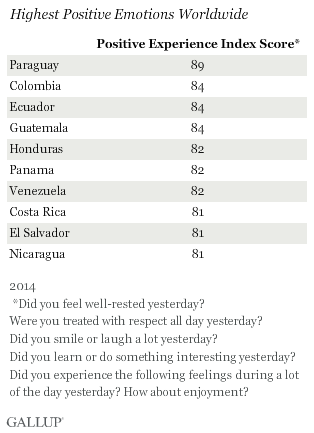 In fact, all of the top ten countries on Gallop's Positive Experience Index this year are in Latin America. Guatemala (#4), Honduras (#5), and El Salvador (#9) all make the list -- and yet this Central American triangle is by far the most violent place on earth right now. What gives?
If Job were a country, it would have to be Guatemala. This little land (the size of Tennessee) suffers plagues of biblical proportions so frequently as to become mundane if not banal. Seismic instability gives rise to the picturesque landscape, and the lush valleys are shadowed by active volcanoes and lay on top of major fault lines. And, looking a bit beyond the verdant fields and colorful dress of the natives, we find crushing poverty.
The murder rate in Guatemala City is 108 per 100,000; this is twice the rate for Baghdad; the comparable figures for New York and Berlin are 6.5 and 1.5. Over 1 in every thousand people in Guatemala City is killed every year—and virtually no one is prosecuted.
And yet, Guatemalans report high levels of quotidian happiness. As I argue in my new book The Good Life, this is partly explained through adaptation to circumstances -- our hedonic happiness is relative to the norms of daily life. We adjust our daily expectations to what is “reasonable” for us and our circumstances, and adapt our daily contentment and hedonic happiness to that norm. It is also a function of culture, of aspirations and visions of the future.
A lot gets lost in translating the lived experiences of
wellbeing and deprivation (joy and pain, hopes and fears) into the numerical
metrics of such rankings. From an anthropological perspective, what is lost is
often what is most important: a subjective understanding of what people value,
what their view of the good life is and could be, the pathways they see for
realizing their aspirations. Perhaps the subjective aspects of wellbeing are
fundamentally different from the more objective and material factors (such as
income and health), even if those material conditions partially determine the
horizons of one’s aspirations.
Friday, March 13, 2015
Third Wave Coffee: How your gourmet coffee habit affects the livelihoods of producers
Americans are drinking much less coffee than they did in the 1940s
and 1950s — down by almost half from a peak in 1946. And such changing
trends in Northern countries have profound impacts in the global South
where coffee is produced.
 The sharp U.S. decline has leveled off
in recent years, buoyed by a dramatic rise in specialty coffee (defined
as scoring above 80 on a 100 point cupping scale). The very best of
these specialty roasts are what the cognoscenti term "Third Wave
coffees." (Barista Parlor's Golden Sound coffee shop in Nashville, TN is pictured at right.)
The sharp U.S. decline has leveled off
in recent years, buoyed by a dramatic rise in specialty coffee (defined
as scoring above 80 on a 100 point cupping scale). The very best of
these specialty roasts are what the cognoscenti term "Third Wave
coffees." (Barista Parlor's Golden Sound coffee shop in Nashville, TN is pictured at right.)
Retailing for $20-$50 a pound (and going much higher), third wave coffees usually come from single farms, with provenance, terroir, and cup quality discussed in the language of fine wines. Coffee's complex flavour profile is especially sensitive to climate, moisture, and soil conditions; and third wave coffees are varietals provenanced from single estates. . . . Read full article on PopAnth here
Retailing for $20-$50 a pound (and going much higher), third wave coffees usually come from single farms, with provenance, terroir, and cup quality discussed in the language of fine wines. Coffee's complex flavour profile is especially sensitive to climate, moisture, and soil conditions; and third wave coffees are varietals provenanced from single estates. . . . Read full article on PopAnth here
Friday, March 6, 2015
Happiness Isn't (Just) a Personal Responsibility
In a recent interview on Wisconsin Public Radio, I made the case that our happiness depends on the happiness or the well-being of people around us. We often think of happiness and wellbeing as an individual responsibility, a view fueled by self-help books and pop psychology. But actually, wellbeing is tied up with aspirations, morals,
dignity and a sense of purpose. In order to feel those things, the right
social structures have to be in place. Read and/or hear the interview here http://www.wpr.org/why-one-scholar-says-happiness-isnt-personal-responsibility
Monday, February 23, 2015
Subscribe to:
Posts (Atom)

 Posts
Posts


